What is a Consumer Court?
A consumer court is a special court in India that deals exclusively with disputes and complaints related to the sale of goods or services. If your new washing machine doesn’t work, or a company overcharges you, or your internet provider never shows up, you can go to the Consumer Court to get help.
It is designed to protect the rights of consumers by providing a legal platform where they can seek redress against unfair trade practices, defective products, poor service, or overcharging. These courts aim to offer a faster and more affordable alternative to traditional civil courts for resolving consumer grievances.
Consumer courts are organized at three levels:
- District Consumer Disputes Redressal Forum (DCDRF) – For claims up to Rs. 50 lakhs-1 Crore
- State Consumer Disputes Redressal Commission (SCDRC) – For claims over Rs. 1 Cr. and Rs. 10 Crores
- National Consumer Disputes Redressal Commission (NCDRC) – For claims above Rs. 10 Crores or appeals against SCDRC decisions.
They function under the Consumer Protection Act, 2019, and are meant to ensure that consumers are not exploited and receive fair treatment in the marketplace.
Valid Grounds for Filing a Complaint
Consumers can file a complaint on various valid grounds:
Defective or Faulty Products:
A product is considered defective if it fails to meet specifications, has manufacturing flaws, or does not function as expected. Examples include a mobile phone malfunctioning shortly after purchase or a faulty appliance.
This ground covers situations where services fall short of promised quality or agreed terms. Common examples include delayed deliveries, subpar repair or maintenance work, or failure to provide promised features in services like hotel stays, medical treatments, or legal assistance.
Overcharging or Deceptive Pricing:
Consumers can complain about hidden charges, prices that do not match advertisements, or excessive charges beyond the fair market value. The Act empowers consumers to challenge such unfair pricing practices and seek refunds or corrections.
False or Misleading Advertisements:
Inaccurate or exaggerated claims in advertisements that mislead consumers into purchasing goods or services under pretenses are actionable. This includes misrepresentation of product features, benefits, performance, or ingredients.
These are business activities designed to deceive, manipulate, or exploit consumers. Examples include selling counterfeit or duplicate products as genuine, enforcing unfair contract terms, or employing deceptive “bait-and-switch” strategies.
Hazardous Goods or Services:
Consumers have the right to expect that purchased goods and services are safe for use. Complaints can be filed for products or services such as contaminated food, cosmetics leading to skin reactions, or defective electrical appliances posing fire risks.
A claim can be initiated against the product manufacturer, seller, or service provider if a defective product causes harm.
This includes issues like breach of contract, unfair contracts, or non-delivery of goods or services despite payment.
Who Can File a Consumer Complaint?
The following individuals and entities are entitled to do so:
- Consumer: Any individual who has purchased goods or services for consideration. This also includes those who did not directly buy the goods but used them with the buyer’s consent, and goods purchased for self-employment rather than resale.
- Voluntary organizations registered under the Companies Act, 1956.
- Central or State Government authorities.
- Multiple consumers with a common interest.
- Beneficiaries of the goods or services in question.
- Legal representatives of a deceased consumer.
- Legal heirs or their representatives.
- Spouse or relatives of the consumer.
How to File a Complaint in Consumer Court?
Before initiating a formal complaint in a consumer court, consumers are encouraged to take preliminary steps to resolve the issue. This initial phase often leads to quicker and less formal resolutions.
Initial Steps Before Formal Filing
Consumers should initially try to resolve the issue directly with the seller or service provider. Many companies have established internal grievance redressal mechanisms, and often, complaints can be resolved efficiently at this stage.
If direct resolution proves unsuccessful, the next recommended step is to send a formal legal notice to the opposing party. This notice should clearly state the issue, detail the deficiency in goods or services, and specify the relief sought, such as replacement, refund, or compensation. A reasonable timeframe, typically 15-30 days, should be given for the resolution.
While sending a legal notice is generally not mandatory for consumer complaints, it is highly recommended as a matter of best practice. This strategy helps consumers get quicker, cheaper resolutions and reduces pressure on the courts. It also motivates businesses to build strong internal grievance systems.
Official Government Process for Consumer Complaint Filing
For consumers opting to file a complaint manually, a structured process ensures all necessary legal requirements are met.
Step 1. Identify the Appropriate Forum
Before taking any action, determine the correct commission or forum to approach. You can choose between District, State, or National forums based on the total value of the goods or services and the compensation you are claiming.
Step 2: Draft Your Complaint
Begin by preparing a clear and detailed complaint document, including the complainant’s details (name, address, contact information) and the opposing party’s details (business name, address). Crucially, it must describe the specific issue, outlining the deficiency, defect, or unfair trade practice encountered.
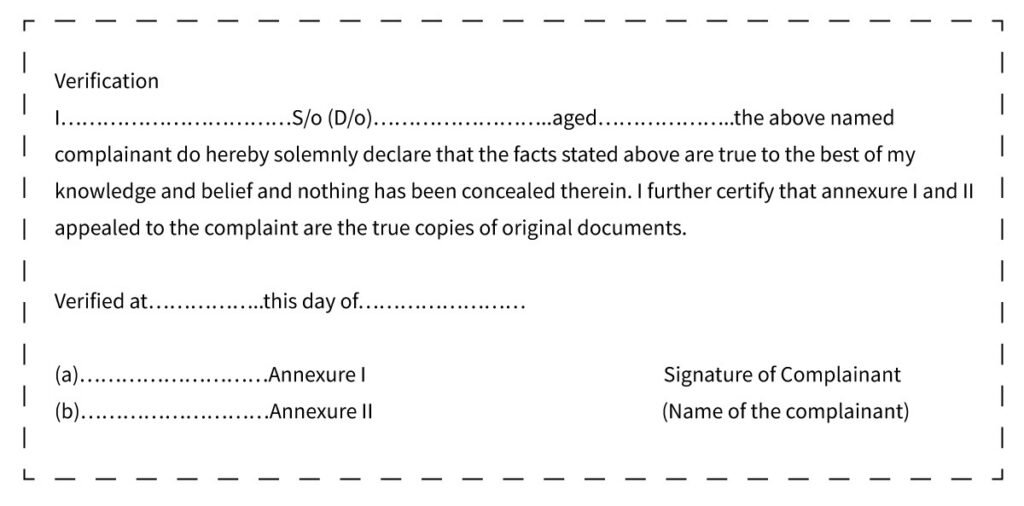
Additionally, the complaint should clearly state the relief sought, whether it is a refund, compensation, or replacement of goods. For authenticity, the complaint must be signed by the complainant and supported by an affidavit, which should then be notarized.
Step 3: Gather Supporting Documents
Key documents typically include:
- Proof of purchase: This can be receipts, invoices, bills, or warranty cards.
- Proof of communication: Any correspondence with the seller or service provider, such as emails, WhatsApp chats, or call recordings, is valuable.
- Evidence of defects: Photographs or video evidence clearly showing the faulty goods or deficient service.
- Agreements: Service agreements or contracts related to the transaction.
- Legal notice: A copy of the formal legal notice sent to the opposing party, if applicable.
- Memo of Parties: A document listing the names and addresses of all parties involved.
- Other relevant documents: Any additional papers that support the complaint.
Step 4: Pay the Prescribed Fee
A nominal fee is required to file the complaint, the amount of which depends on the value of the claim. This fee can typically be paid through a demand draft or online. It is important to note that complaints with a value up to Rs. 5 lakh are exempt from any filing fee.
Step 5: File the Complaint
The prepared complaint, along with all supporting documents and additional copies, must be submitted physically to the appropriate consumer court. The National Consumer Disputes Redressal Commission (NCDRC), headquartered in New Delhi, serves as the highest authority for consumer dispute resolution in India. It functions as the apex consumer court at the national level.
Here’s how the consumer court system is structured:
- NCDRC (National Level): Based in New Delhi, it is the top-tier consumer court in the country.
- SCDRC (State Level): Every state has its own State Consumer Disputes Redressal Commission.
- DCDRF (District Level): Each district operates a District Consumer Disputes Redressal Forum.
Upon submission, the complainant will receive a unique complaint number and a date for the initial hearing.
Step 6: Attend Hearings
Once the complaint is accepted, the consumer court will issue a notice to the opposing party, informing them of the complaint and the scheduled hearing. Both parties will then have the opportunity to present their arguments and evidence before the court. Hearings will continue as necessary until a final decision is reached.
Digital Process For Consumer Complaint Filing (E-Daakhil Portal)
The E-Daakhil portal is a digital platform introduced by the National Consumer Disputes Redressal Commission (NCDRC). This innovative platform significantly streamlines the consumer grievance redressal process by allowing consumers to file complaints without the need for physical visits to the consumer court.
The benefits of using E-Daakhil are substantial:
- It offers convenient access from the comfort of one’s home.
- It is time-saving by avoiding long queues and extensive paperwork.
- Provides transparency through real-time online tracking of complaint status.
- Has a user-friendly interface, ensuring a paperless and transparent process for all users.
Here’s how you can file a complaint via the E-Daakhil portal:
- First, visit the official E-Daakhil portal: edaakhil.nic.in
- Register and create an account using your details.
- Once logged in, draft the detailed complaint, similar to the manual process mentioned above. All supporting documents should be uploaded digitally.
- The prescribed fee (ranging from Rs. 200 – 1,000) has to be paid securely online.
- Upon submission, the system provides a unique complaint number for future reference.
Consumers can track their complaint status online and receive email or mobile notifications regarding their progress.
Navigating the E-Daakhil portal can have a learning curve. For a streamlined and error-free submission, services like RegisterKaro can manage the entire digital filing process for you.
Which Consumer Court (Commission) Should You Approach?
Choosing the correct Consumer Commission is a vital step in the complaint process. The appropriate commission is determined by two key factors:
Pecuniary Jurisdiction:
Based on the monetary value of the goods or services involved. The Consumer Protection Act, 2019, sets clear monetary thresholds for each level of commission, and these limits have been constitutionally upheld by the Supreme Court.
Territorial Jurisdiction:
Depending on the geographical location of the parties or the cause of action. Consumers have several options for filing based on location:
- The complaint can be filed in the Consumer Commission where the opposing party (the company or service provider) resides or carries on business.
- Alternatively, filing is permissible where the opposing party has a branch office or personally works for gain.
- A complaint can also be filed where the cause of action—the event or circumstances leading to the dispute—occurred, either wholly or in part.
- Significantly, consumers may also file in a forum where they reside or work for gain, offering a convenient option.
- If multiple opposing parties are involved, the complaint can be filed in any forum where at least one of the parties resides or conducts business.
Appellate Jurisdiction:
In case of dissatisfaction with the outcome of:
- The District Forum: Consumers can file an appeal with the State Commission.
- State Commission: The consumer can further appeal to the National Commission.
- National Commission: Consumers have the option to approach the Supreme Court for a final appeal.
Consumers should always refer to the latest provisions of the Act for the most precise and up-to-date figures.
Consumer Court Fees in India
Filing a consumer complaint involves a nominal fee, which varies based on the “value of goods or services paid as consideration”.
Here’s a breakdown of the current court fees:
District Consumer Disputes Redressal Forum (DCDRF):
- Up to ₹5 Lakh: No fee (Nil)
- Above ₹5 Lakh and up to ₹10 Lakh: ₹200
- Above ₹10 Lakh and up to ₹20 Lakh: ₹400
- Above ₹20 Lakh: ₹1,000
State Consumer Disputes Redressal Commission (SCDRC):
- Above ₹50 Lakh and up to ₹1 Crore: ₹2,000
- Above ₹1 Crore: ₹2,500
National Consumer Disputes Redressal Commission (NCDRC):
- Above ₹2 Crores and up to ₹4 Crores: ₹3,000
- Above ₹4 Crores and up to ₹6 Crores: ₹4,000
- Above ₹6 Crores and up to ₹8 Crores: ₹5,000
- Above ₹8 Crores and up to ₹10 Crores: ₹6,000
- Above ₹10 Crores: ₹7,500