
GSTR-9 Annual Return Filing Online in India
Avoid penalties and last-minute stress with reliable GSTR-9 return filing. Stay compliant with GST laws and ensure your business meets all regulatory requirements before the due date. What you get:
- Expert-Led GSTR-9 Filing Support
- Accurate Computation & Reconciliation
- GSTIN-Level Reporting & Validation
- CA-Reviewed for Accuracy
- Trusted by 20,000+ Businesses & Professionals
Enter your details to receive a full quote and consultation
By clicking, you consent to receiving updates about our services as outlined in our Privacy Statement.

4.6 out of 5

4.7 out of 5
What Sets Us Apart
500+ MCA Certified Experts
10,000+ Verified Reviews
2500+ Monthly Clients Onboardings
Serving Businesses Across India
What is GSTR-9?
GSTR-9 is an annual return that GST-registered persons are required to submit at the close of every financial year. It provides a detailed summary of all GST transactions reported through monthly or quarterly returns like GSTR-1 (outward supplies) and GSTR-3B (summary return).
The form includes details of:
- Sales and purchases made during the financial year,
- Input Tax Credit (ITC) claimed and reversed,
- Taxes paid under Central Goods and Services Tax (CGST), State Goods and Services Tax (SGST), Integrated Goods and Services Tax (IGST), and Cess,
- Interest, refunds, and demand adjustments (if any).
Purpose of Filing GSTR-9
The main reasons for filing GSTR-9 are to:
- Match data: Align information reported in monthly/quarterly returns (GSTR-1 and GSTR-3B) with the taxpayer’s yearly financial records.
- Ensure compliance: Provide a full yearly declaration of GST transactions with all GST laws.
- Identify discrepancies: Assist taxpayers and authorities in detecting errors or inconsistencies in previously filed GST returns.
- Summarise data: Provide a concise, unified summary of all GST transactions for the entire financial year.
Different Forms Under GSTR-9 Annual Return
While GSTR-9 is the main annual return form under GST, there are a few related forms designed for different types of taxpayers and reporting needs. Each serves a specific purpose depending on the taxpayer’s registration type, turnover, and role in the GST system.
Here’s a breakdown of the different forms:
- GSTR-9: This is the standard annual return form for regular taxpayers registered under GST. It includes consolidated details of outward and inward supplies, ITC, tax paid, and other related information for the full financial year.
- GSTR-9B: This form is an annual statement for e-commerce operators who collect Tax at Source (TCS) and file Form GSTR-8. It is intended to be a consolidated summary of all TCS collected by the operator during the financial year.
- Note: The requirement to file GSTR-9B has been deferred by the government since its introduction. Therefore, e-commerce operators are currently not required to file it.
- GSTR-9C: This is a reconciliation statement for taxpayers whose annual turnover exceeds Rs. 5 crores (applicable from FY 2020–21 onwards; earlier the limit was Rs. 2 crore).
It includes:
- A comparison between the data filed in GSTR-9 and the audited financial statements.
- The form must be self-certified by the taxpayer (audit by a CA or CMA was required earlier, but is now optional).
- Helps ensure transparency and accuracy in reporting.
Choosing the right form and understanding your GSTR-9 filing eligibility is essential to ensure error-free annual return filing under GST.
Note: GSTR-9A has been suspended and replaced by GSTR-4 for annual filing from FY 2019-20 onwards. This form is meant for taxpayers under the Composition Scheme, which allows small businesses to pay tax at a fixed rate.
Who is Required to File GSTR-9?
Most regular GST-registered taxpayers must file the GSTR-9 annual return, depending on their turnover and category.
If your annual turnover is more than Rs. 2 crore, filing GSTR-9 is mandatory. For businesses with a turnover up to Rs. 2 crore, filing GSTR-9 is optional. This rule helps smaller businesses reduce their compliance burden.
| Annual Turnover | GSTR-9 Filing Requirement |
|---|---|
| More than Rs. 2 crore | Must file GSTR-9 |
| Rs. 2 crore or less | Filing is optional |
Exclusions from Form GSTR-9 Filing
Not all registered taxpayers are required to file GSTR-9, the annual GST return. The following categories are specifically excluded:
- Casual Taxable Persons – These are individuals or entities registered for a limited period (like for exhibitions or seasonal businesses). Since their registration is not ongoing, they are exempt from filing GSTR-9.
- Input Service Distributors (ISDs) – ISDs distribute the input tax credit to their branches or units. They don’t supply goods or services directly, so they aren’t required to file the annual return.
- Non-Resident Taxable Persons – These are foreign individuals or businesses providing goods or services in India without a permanent place of business. Due to their short-term presence, they are exempt from the annual filing.
- TCS Collectors under Section 52 of the GST Act – E-commerce operators collecting Tax Collected at Source (TCS) from suppliers are not required to file GSTR-9, as their compliance is governed under a different section.
- TDS Deductors under Section 51 of the GST Act – Government departments or agencies that deduct Tax Deducted at Source (TDS) are also excluded, as they do not engage in the regular supply of goods or services.
- Online Information Database Access and Retrieval (OIDAR) Services – OIDAR service providers supply services like software, cloud storage, or streaming to Indian consumers. They are exempt from GSTR-9 filing.
Documents Required to File GSTR-9 in India
To correctly file GSTR 9 online, you will need these documents and information:
- GSTR-1 data: Details of all sales for the financial year.
- GSTR-3B data: Summary of GST taxes owed and ITC claimed for the financial year.
- Audited Financial Statements: Profit & Loss Account and Balance Sheet, especially if you need to file GSTR-9C for reconciliation.
- Books of Accounts: Purchase and sales records, expense ledgers, and other accounting documents for cross-checking data.
- Reconciliation Statements: Documents showing any differences between your GSTR-1, GSTR-3B, and accounting books.
- ITC Register: Details of all input tax credits taken, reversed, or denied during the year.
- HSN-wise Summary: Breakdown of outward and inward supplies according to Harmonized System of Nomenclature (HSN) codes. This summary is a mandatory part of the GSTR-9 return.
Having these documents ready will help ensure a smooth and accurate GSTR-9 filing process.
How to File GSTR 9 Online?
You must file GSTR-1 and GSTR-3B for the full financial year before filing GSTR-9. The GSTR 9 filing process involves several steps to ensure accuracy and follow the rules.
Here’s how to file the GSTR 9 annual return online:
1. Log in to GST Portal: Go to the GST portal (gst.gov.in) using your login details.
2. Go to Returns Dashboard: Select the financial year for which you want to file GSTR-9.
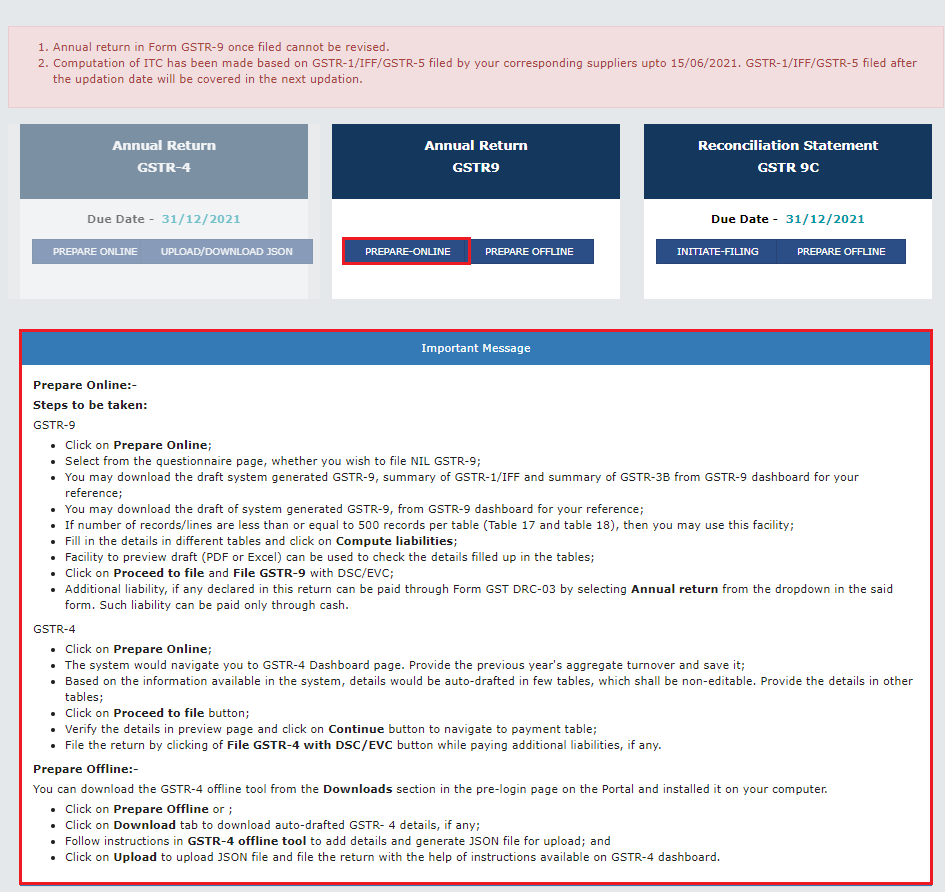
3. Start GSTR-9 Filing: Choose “Prepare Online” or “Prepare Offline.” The ‘Prepare Online’ option is suitable for taxpayers with a smaller volume of data.
4. Check Auto-Populated Data: The system will fill in many fields based on your filed GSTR-1 and GSTR-3B returns. Carefully check this data against your records.
5. Enter Missing Details: Manually enter any additional required information in the various tables of GSTR-9, such as:
- Details of sales and purchases reported during the financial year.
- Details of ITC reported, reversed, or not allowed.
- Details of tax paid, including tax due and tax paid by cash or ITC.
- Include any changes or corrections made this year for transactions from the previous financial year. These revised entries are reported in the current year’s return.
- The HSN Summary is important in GSTR-9 for both sales and purchases, as this offers important data for review.
6. Calculate Taxes Due: The portal will calculate any additional tax liability.
7. Make Payment (if any): Pay any outstanding taxes or late filing fees.
8. Preview and Check: Download the draft GSTR-9 and carefully look over all the details for errors before final submission.
9. Submit the Return: Once satisfied, send the return using a Digital Signature Certificate (DSC) or Electronic Verification Code (EVC).
10. File GSTR-9C (if it applies): If your annual turnover exceeds Rs. 5 crore, file GSTR-9C after submitting GSTR-9.
Note: You must file GSTR-1 and GSTR-3B for the entire financial year before submitting GSTR-9.
GSTR-9 Return Filing Fees
There are no official fees charged by the government for filing GSTR-9 on the GST portal. Filing your annual return is free if done directly online. However, significant penalties apply for late filing or non-filing of GSTR-9. These penalties are significant and are applied to ensure on-time compliance.
If you choose to hire a GST professional or use paid software for filing, the costs generally range as follows:
- Professional Fees: Rs. 1000 to Rs. 3,000 per GSTR-9 filing, depending on the complexity and service provider.
- Paid Software Charges: Rs. 300 to Rs. 1,500, depending on the features and support offered.
These fees vary based on the service quality and volume of filings handled.
GSTR 9 Due Dates & Late Filing Penalties
The GSTR 9 filing due date is usually December 31st of the year after the relevant financial year. For example, for the financial year 2024-25, the GSTR-9 due date would be December 31, 2025. Following this GSTR 9 filing date is important to avoid penalties.
Penalty for late filing of GSTR 9 / GSTR 9 late filing fees:
- A late fee of ₹200 per day (₹100 for CGST and ₹100 for SGST) is charged for each day of delay, up to a maximum of 0.5% of the taxpayer’s turnover in the State or Union Territory (0.25% for CGST and 0.25% for SGST).
- Late fees must be paid in cash. They cannot be paid using an Input Tax Credit.
- Interest at 18% per year may be charged on any outstanding tax amount. This applies only to the net tax paid in cash, not to the entire turnover.
- In cases of significant delay, these penalties can add up quickly, making it costly to miss the deadline.
Filing GSTR-9 on time helps avoid these fees and keeps your GST compliance in good standing, making future audits and assessments smoother.
Format of GSTR 9 Annual Return
The format of the GSTR-9 return is divided into several parts, each requiring specific information as per the GST rules. Generally, it covers:
- Part I: Basic Details: Financial Year, GSTIN, Official Name, Business Name.
- Part II: Details of Outward and Inward Supplies declared during the financial year: This includes taxable outward goods/services, zero-rated goods/services, exempted goods/services, and goods/services where tax is paid under reverse charge.
- Part III: Details of ITC declared in returns filed during the financial year: Information on ITC taken, ITC reversed, and net ITC available.
- Part IV: Details of tax paid as declared in returns filed during the financial year: Details of tax owed and tax paid.
- Part V: Details of previous year’s transactions reported between April and September of the current year, or up to the date of filing the previous year’s annual return, whichever comes first. This section records any changes made to last year’s transactions that are reported in the current financial year.
- Part VI: Other Information: This includes details like demands and refunds, HSN-wise summary of sales and purchases, and late fees due and paid.
The GSTR 9 annual return is a detailed document. Understanding each section is key to accurate filing. A checklist for filing GSTR 9 can be very helpful to make sure all needed details are covered and prevent common mistakes.
Connect with AccountingKaro and let our experts handle the legal hassle while you grow your business.
Frequently Asked Questions (FAQs)
Who has to file GSTR 9?
Every registered taxpayer under GST must file a GSTR-9. Exceptions include temporary taxable persons, non-resident taxable persons, Input Service Distributors, and those who must deduct or collect TDS/TCS. It is required for businesses with total yearly sales over Rs. 2 crore.
Is it mandatory to file GSTR 9?
Yes, it is mandatory to file GSTR-9 if your total yearly sales are over Rs. 2 crore. For businesses with sales up to Rs. 2 crore, filing is optional, offering flexibility.
What if GSTR 9 is wrongly filed?
Once GSTR-9 is filed, it generally cannot be revised. However, errors or omissions from the past year can usually be corrected in the current year’s monthly or quarterly returns (GSTR-1 and GSTR-3B) up to the GSTR-9 due date for the current year or the filing of the past year’s annual return, whichever is earlier.
Is the HSN Summary important in GSTR-9?
Yes, providing the HSN (Harmonized System of Nomenclature) summary for both sales and purchases is important in GSTR-9. This detail helps sort goods and services for better tracking and review by tax authorities, adding to clarity.
How many subcategories are there under GSTR 9?
GSTR-9 has six main parts. These are further divided into many tables and sub-sections, needing detailed information about various GST dealings. These divisions ensure full reporting.
Is there any late fee if there is a delay in filing GSTR9?
Yes, there is a penalty for late filing of GSTR 9. A late fee of Rs. 200 per day (Rs. 100 each for CGST and SGST) is charged, with a limit of 0.25% of the taxpayer’s sales in the state or union territory. This fee serves as a strong deterrent to late filing.
Can I file GSTR 9 after the due date?
Yes, you can file GSTR-9 after the due date, but you will incur a late fee for each day of delay, up to the maximum limit. Filing before the GSTR 9 filing due date is highly advised to avoid these penalties and maintain good compliance.
What is the difference between GSTR9 and 9C?
GSTR-9 is the annual return that summarises all GST returns filed during the financial year. GSTR-9C is a matching statement that compares the GSTR-9 data with the taxpayer’s audited annual financial statements. GSTR-9C is needed for businesses with total yearly sales over Rs. 5 crore (before, Rs. 2 crore) and needs to be self-certified. GSTR-9 must be filed before or at the same time as GSTR-9C.
How to check the GSTR 9 filing status?
You can check your GSTR-9 filing status by following these steps:
- Visit the GST portal: gst.gov.in
- Log in with your credentials
- Go to the Returns Dashboard
- Select the relevant financial year
- View your GSTR-9 filing status and track your progress
This simple process helps you stay updated on your return filing.
What are the GSTR 9 filing exemptions?
The exemptions from GSTR-9 filing include temporary taxable persons, non-resident taxable persons, Input Service Distributors, and those who deduct or collect TDS/TCS. Also, for sales up to Rs. 2 crore, it is not required, making things easier for smaller businesses.
Is there any option to file a Nil GSTR 9?
Yes, if there are no transactions during the financial year and no tax owed, you can file a NIL GSTR-9. The late fee for NIL GSTR-9 filing is reduced to Rs. 100 per day (Rs. 50 for CGST and Rs. 50 for SGST), making it a simpler process for businesses with no activity.
Why Choose AccountingKaro for the GSTR-9 Filing Services?
You should choose AccountingKaro for your GSTR-9 filing because we offer expert support, reliable service, and complete peace of mind. Here are the top reasons:
- CA-Reviewed Filing: Benefit from Chartered Accountant-reviewed filings that boost accuracy and compliance, reducing the risk of audits or notices.
- Hassle-Free Process: We manage data reconciliation, error checks, and online submission for you.
- Timely Reminders: Stay on top of deadlines with automated alerts so you never miss your GSTR-9 due date.
- Secure & Confidential: Your financial data is protected with strict security measures.
- Affordable Pricing: Professional service at competitive rates for filing with no hidden fees.

S
Sanket Chawre
- Verified
Others
We had been struggling with many things during our LLP setup with RegisterKaro until Sonal stepped in as our compliance officer and overall liason. So…
Date Posted
2025-12-23
A
Ayusha Kumar
- Verified
Others
I had a great experience getting my company incorporated with the help of Ms. Anchal Gupta. She managed the entire process very efficiently and profes…
Date Posted
2025-12-23
P
Pradip Vernekar
- Verified
Others
I had an excellent experience with RegisterKaro. Atisha Jain and the team made the process of getting my GST certificate seamless and hassle-free. The…
Date Posted
2025-12-23
D
Dhariya
- Verified
Others
I recently had a great experience with RegisterKaro and their employee, Satyapriya Tripathi. They provided exceptional assistance with my professional…
Date Posted
2025-12-23
Latest Blogs

January 14,2026
What are CDSCO Guidelines for Medical Devices?
Joel Dsouza
Learn about CDSCO guidelines for medical devices in India. This guide covers classification, approval process, and compliance for manufacturers & importers.

January 14,2026
What are the Documents Required for a Trade License?
Srihari Dhondalay
Learn about the documents required for a trade license in India. This checklist covers key requirements, forms, renewal documents, and specific cases.

January 14,2026
How to Download the FSSAI Certificate Online? 2026 Guide
Joel Dsouza
Learn how to download an FSSAI certificate online using FOSCOS. This guide covers the process, license number method, and registration certificate steps.

January 14,2026
How to Get a Trade License for a Dental Clinic?
Srihari Dhondalay
Learn how to get a trade license for a dental clinic in India. Know the eligibility, process, and documents needed for clinic license registration.

January 14,2026
What is a Trade License? Eligibility, Types & Process
Joel Dsouza
Learn what a trade license is in India, its purpose, and key types. This article covers eligibility, fees, and the complete process to apply easily.

January 14,2026
Why is CDSCO Form 44 Important for New Drug Approval?
Joel Dsouza
Learn why CDSCO Form 44 is crucial for new drug approval in India. Explore its checklist, process, and documents needed for filing Form 44 with CDSCO.
Featured In