
These are additional charges if you opt to use the services of a consultant or professional agency to assist you with the FSSAI State License application process. These fees are not fixed by the FSSAI and will vary depending on the service provider and the complexity of your application.
FSSAI State License
Register your food business for an FSSAI State License with AccountingKaro. Meet state-level food safety requirements through expert-led filing, legal guidance, and reliable end-to-end registration support.
- Fast Approval for FSSAI State License
- State-Specific Regulatory Guidance
- Support for Businesses with ₹12–20 Cr Turnover
- Renewal and Modification Assistance
- Post-License Compliance Support
Enter your details to receive a full quote and consultation
By clicking, you consent to receiving updates about our services as outlined in our Privacy Statement.

4.6 out of 5

4.7 out of 5
What Sets Us Apart
500+ MCA Certified Experts
10,000+ Verified Reviews
2500+ Monthly Clients Onboardings
Serving Businesses Across India
What is the FSSAI State License?
An FSSAI State License is a key food permit from the Food Safety and Standards Authority of India. It ensures food businesses follow safety rules. This license is specifically designed for medium-sized Food Business Operators (FBOs) whose operations are limited to a single state in India. It is a mandatory requirement for businesses with an annual turnover generally ranging from ₹12 lakh to ₹20 crore.
Who needs an FSSAI State License?
The FSSAI State License is required for various types of food businesses, including:
- Manufacturers and Processors: Medium-scale units.
- Storage Units: Excluding those with cold and controlled atmospheres, and specific large capacities.
- Wholesalers, Retailers, and Distributors: Businesses involved in the supply chain within a state.
- Food Service Establishments: Such as restaurants, canteens, caterers, hotels (excluding those with 5-star and above ratings), and dhabas.
- Transporters: With up to 100 vehicles operating within a single state.
- Relabellers and Repackers: Businesses that handle the relabeling or repackaging of food products.
FSSAI License Types: Basic vs State vs Central License
The key differences between the licenses are based on turnover and the scale of operations:
| Cost Component | Description | Approximate Cost (₹) |
|---|---|---|
| Consultant Fees | Hiring a fire safety consultant for assessment and planning | 10,000 – 50,000 |
| Fire Safety Equipment Installation | Installing extinguishers, alarms, hydrants, sprinklers, etc. | 20,000 – 1,00,000+ |
| Inspection Fees | Fee charged by the fire department for inspections | 5,000 – 20,000 |
Benefits of Getting an FSSAI State License in India
Obtaining an FSSAI State License offers numerous advantages for food businesses:
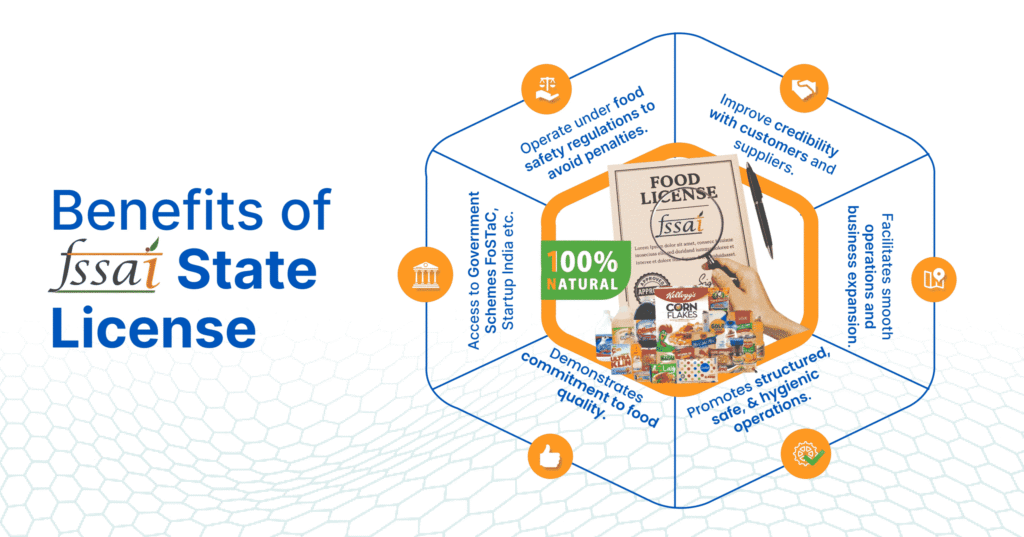
- Legal Compliance: It ensures your business operates within the legal framework, avoiding penalties and legal complications.
- Enhanced Credibility and Trust: Having a license builds trust with your customers, suppliers, and even banks, signifying adherence to quality and safety standards.
- Market Expansion: Facilitates smoother operations and potential expansion within the state, as many businesses prefer to partner with licensed entities.
- Brand Reputation: Helps in building a strong and reliable brand image associated with food safety and quality.
- Improved Business Practices: The process of obtaining and maintaining the license often leads to better hygiene and operational practices within the business.
- Access to Government Schemes: Licensed FBOs (Food Business Operators) may be eligible for various government initiatives and subsidies, like:
- PM-FME Scheme (Pradhan Mantri Formalisation of Micro Food Processing Enterprises Scheme): Subsidies for micro food processing units.
- FoSTaC (Food Safety Training and Certification): Free food safety training.
- Startup India: Support for innovative food startups.
- Horticulture Board Grants: Aid for cold storage and processing.
Eligibility Criteria for FSSAI State License
Eligibility for an FSSAI State License depends on your business’s annual turnover, operational scale, and type. Here’s more information:
1. Eligibility by Annual Turnover
As a primary determinant, a food business must have an annual turnover ranging from ₹12 lakh to ₹20 crore to be eligible for an FSSAI State License. Businesses falling below this threshold require Basic Registration, while those exceeding ₹20 crore need a Central License.
2. Eligibility by Business Type and Production Capacity
Beyond turnover, specific business types and their respective capacities also define FSSAI state license eligibility:
- Manufacturing and Processing Units:
- General food products: Up to 2 Metric Tons (MT) per day (excluding milk and meat).
- Milk handling: Between 501 to 50,000 liters of milk per day.
- Milk solids: Between 501 MT to 2500 MT per annum.
- Meat processing: Up to 500 kg per day or 150 MT per annum.
- Storage Units: Facilities with a storage capacity of up to 10,000 MT.
- Wholesalers, Distributors, and Retailers: These businesses are eligible if their annual turnover is within the stipulated range of ₹12 lakh to ₹20 crore.
- Food Service Establishments: This includes all hotels (except those rated 5-star and above), restaurants, canteens, caterers, clubs, and banquet halls with food catering arrangements falling within the turnover criteria.
- Transporters: Operating up to 100 vehicles within a single state.
- Relabellers and Repackers: Businesses engaged in these activities.
Documents Required for FSSAI State License
Having all the necessary FSSAI state license documents ready is key to a seamless application process. The requirements vary based on the type and structure of your food business.
1. Documents for All Businesses
These are fundamental documents required irrespective of your specific food business type:
- Aadhaar Card, Voter ID, PAN Card of the Proprietor/Partners/Directors/Authorized Signatory.
- Recent utility bill (electricity, water, gas) or bank statement for the Proprietor/Partners/Directors.
- Recent photos of the Proprietor/Partners/Directors/Authorized Signatory.
- Rental Agreement (if rented), Sale Deed, or Property Papers (if owned).
- No Objection Certificate (NOC) from the landlord, if the business premises are rented.
- Declaration Form as prescribed by FSSAI, affirming compliance.
- Copy of Certificate of Incorporation (for Companies) / Partnership Deed (for Partnership Firms) / Trust Deed (for Trusts).
- Memorandum of Association (MoA) and Articles of Association (AoA) for companies, detailing objectives and internal regulations.
- List of Directors/Partners/Trustees: With their full names, addresses, and contact details.
- Board Resolution/Authorization Letter: Clearly stating the authorized person to sign and submit the FSSAI application on behalf of the entity.
- GST Registration Certificate (if applicable)
- Trade license / Shop & Establishment Certificate (if applicable)
2. Documents for Manufacturing and Processing Units
In addition to the general documents, manufacturing and processing units have specific requirements:
- Layout Plan of the Processing Unit: A detailed drawing indicating the dimensions and area allocation of various sections (e.g., processing area, washing area, storage, etc.).
- List of Equipment and Machinery: Including their capacity and horsepower.
- Details of Raw Materials: A list of primary raw materials used.
- Water Analysis Report: From a recognized public health laboratory, especially if water is used as an ingredient or for processing.
- Source of Milk/Meat: If applicable, details of the sourcing.
- Pest Control Certificate: If applicable, from a certified agency.
- Recall Plan: For businesses dealing with high-risk food categories (often a requirement for a central license, but good practice for the state).
3. Documents for Specific Businesses like Transporters and Relabellers
- For Transporters: A comprehensive list of all vehicles with their registration numbers and carrying capacities.
- For Relabellers/Repackers: A copy of the agreement with the original manufacturer, if applicable, to ensure traceability and accountability.
How to Apply for FSSAI State License Online via the FoSCoS Portal?
The FSSAI State License registration process is streamlined and primarily conducted online through the FoSCoS (Food Safety and Compliance System) portal (foscos.fssai.gov.in). Here’s how to do it:
Step 1: Visit the FoSCoS Portal and Start Your Application
Begin by visiting the official FoSCoS portal (foscos.fssai.gov.in). On the homepage, locate and click on the “Apply for License/Registration” under the License/Registration section to initiate your application.
Step 2: Select the Right Kind of Business
First, select your state from the dropdown menu. After that, choose the appropriate license or registration type. Based on your business’s annual turnover and operational scope, select “State License” to proceed. This ensures you fill out the correct application form, Form B.
Step 3: Fill Form B with Accurate Business Details
Form B is the core application form for a state license. Carefully fill in all the required details, ensuring accuracy to prevent delays or rejection. This includes:
- Complete business name and registered address (FSSAI-compliant).
- Detailed contact information (email, mobile number).
- Specific type of food business (e.g., manufacturer of bakery products, distributor of packaged goods).
- List of food categories you deal with.
- Accurate annual turnover figures.
- Details of the authorized person who will be responsible for the application.
Step 4: Upload All Necessary Documents
This is a crucial step in the FSSAI State License application process. You must upload scanned copies of all required documents through the official FSSAI online portal.
Refer to the detailed checklist in the ‘Documents Required for FSSAI State License’ section below.
Key to remember:
- Clarity and Format: Make sure all your scanned documents are clear and easy to read. They should be in PDF, JPEG, or PNG format, as specified by the portal.
- File Size: Each document file must be within the system’s maximum file size limit, typically between 2-5 MB.
Note: Submitting incorrect documents can lead to rejection or delays. Always double-check your files before uploading. Document requirements may vary by business type, and the portal will show a customized checklist accordingly.
Step 5: Pay the Application Fee Online
After completing Form B and uploading all necessary supporting documents, you will proceed to the payment gateway to pay the applicable FSSAI State License fees online.
Here are the key points regarding the payment:
- Online Payment Methods: You can conveniently make the payment using:
- Net banking
- Credit card
- Debit card
- Variable Fee: The license fee is not fixed; it varies based on the validity period you choose for your license. You can select a validity period ranging from 1 to 5 years.
Note: Try to keep copies of all transaction receipts for future reference.
Step 6: Track Your Application Status
Upon successful payment, an application reference number will be generated. This number is essential for tracking the progress of your FSSAI state licensing & registration. You can monitor your application’s status on the FoSCoS portal.
The application will be reviewed by the FSSAI authorities. They may request additional documents or clarifications, especially for new State License applications. Please note, the application can also be rejected if it doesn’t meet the required criteria.
If approved, you will receive your FSSAI State License Certificate, which can be downloaded from the portal.
FSSAI State License Fees
The overall FSSAI state license cost comprises government fees and, optionally, professional fees if you seek assistance. Here’s the breakdown:
1. Government Fees for New FSSAI State License
The government fee for a new FSSAI State License is fixed by the FSSAI and varies based on the type of business and the chosen validity period. Here’s the detail:
| Type of Business | Annual Government Fee (₹) |
|---|---|
| Manufacturer (1MT–2MT production/day or 10,001–50,000 Ltrs milk/day) | 5,000 |
| Manufacturer (101 kg/Ltrs–1MT production/day or 501–10,000 Ltrs milk/day) | 3,000 |
| Hotels (3-star and 4-star) | 5,000 |
| Food Service Providers (Restaurants, Canteens, Caterers, etc.) | 2,000 |
| Wholesalers, Retailers, Distributors, Transporters, Storage (up to 10,000 MT) | 2,000 |
Note: The total fee will be the annual fee multiplied by the number of years you apply for (up to 5 years). For example, a 3-year license for a retail business will cost ₹2,000 * 3 = ₹6,000 in government fees.
2. Professional Fees
FSSAI State License Validity & Renewal
An FSSAI State License is valid for a period chosen by the Food Business Operator (FBO) at the time of application. This period can range from a minimum of 1 year to a maximum of 5 years.
For any business operating under a state FSSAI licence, understanding the renewal process is essential to avoid penalties.
Note: FBOS must keep track of their license’s expiry date to ensure timely renewal and maintain uninterrupted legal operations.
When to Renew Your FSSAI License?
FBOS must apply for renewal of the FSSAI license at least 30 days before the expiry date of their existing FSSAI State License. The FoSCoS portal initiates reminders to registered email addresses as the license expiry approaches.
- Renewal Window: The renewal process on the FoSCoS portal typically opens 120 days before the expiry date.
- Late Fee: If the renewal application is filed between 90 days and the expiry date, a late fee of ₹100 per day will be levied in addition to the standard renewal fee.
- After Expiry: If the license is not renewed before its expiry date, it will become invalid. In such cases, the FBO will need to apply for a fresh FSSAI State License as if it were a new registration, which can involve a different process and potentially higher costs and inspections.
Documents for FSSAI State License renewal are similar to a new application, plus existing license details. For eg, you’ll need your license number, completed Form B, and any updated documents like a new rent agreement or director details.
Common FSSAI State License Application Mistakes to Avoid
Avoiding common errors can significantly improve the success rate of your FSSAI state license process.
- Incorrect Business Category Selection: Choosing the wrong ‘Kind of Business’ (KoB) or license type (Basic, State, Central) based on turnover or operational scope.
- Incomplete or Incorrect Form B: Errors or omissions in filling out the mandatory Form B, leading to discrepancies.
- Inadequate Documents: Not uploading all required FSSAI state license documents, or submitting unclear, expired, or invalid proofs.
- Mismatched Details: Discrepancies between information provided in the application form and the supporting documents (e.g., address, name).
- Improper Layout Plan: For manufacturing units, a layout plan that doesn’t meet FSSAI specifications or is unclear.
- Unclear Product Categories: Not specifying all the food products or categories handled by the business.
- Late Renewal: Failing to initiate fssai state license renewal within the stipulated timeframe, leading to expiry and requiring a fresh application.
- Non-payment/Incorrect Payment: Issues with the online payment of FSSAI state license fees.
Penalties for FSSAI Non-Compliance
Operating a food business in India without a valid FSSAI license or failing to comply with the Food Safety and Standards (FSS) Act, 2006, carries severe penalties. These include:
- Operating Without a License (Section 63): Fines up to ₹5 lakh and/or imprisonment up to 6 months.
- Selling Substandard Food (Section 51): Fines up to ₹5 lakh for food not meeting prescribed quality standards.
- Misleading Advertisements (Section 53): Fines up to ₹10 lakh.
- Unsafe Food (Section 59): The severity of the punishment depends on the extent of injury caused by the unsafe food, including:
- No injury: Fine up to ₹1 lakh.
- Non-grievous injury: Imprisonment up to 6 months and/or fine up to ₹5 lakh.
- Grievous injury: Imprisonment up to 1 year and/or fine up to ₹10 lakh.
- Death: Imprisonment up to 7 years and a fine not less than ₹10 lakh.
- Hindering a Food Safety Officer (FSO) (Section 62): Fines up to ₹1 lakh and/or imprisonment up to 3 months.
- Business Closure: FSSAI can order the immediate cessation of operations for severe or repeated violations.
- Reputational Damage: Significant loss of consumer trust and market share due to tarnished image.
Key Compliance Responsibilities for FSSAI State License
Beyond obtaining the state license FSSAI, FBOs must adhere to continuous compliance responsibilities to maintain their license and ensure food safety:
- Adherence to Food Safety Standards: Consistently follow the hygiene and sanitary requirements outlined in Schedule 4 of the FSSAI regulations.
- Maintenance of Records: Keep comprehensive records of raw material procurement, production, sales, quality checks, and customer complaints.
- Training of Food Handlers: Ensure all personnel involved in food handling are adequately trained in food safety and hygiene, often through FoSTaC-certified programs.
- Display of License: The FSSAI license must be prominently displayed at the business premises.
- Product Labelling: All packaged food products must comply with FSSAI’s labeling regulations.
- Regular Audits and Inspections: Cooperate fully with FSSAI officials during routine inspections and audits, providing all requested information.
- Grievance Redressal Mechanism: Establish a system for addressing consumer complaints related to food safety.
FSSAI State License Certificate
Once your application is approved by the FSSAI authorities, you will be issued an official FSSAI State License Certificate. This certificate is mandatory for running any food business legally and must be displayed at your business premises.
This certificate contains crucial details such as the license number, validity period, business name, address, and product categories permitted under the license. It serves as proof of compliance with food safety regulations and builds trust with consumers, suppliers, and regulatory bodies alike.
How to Download the FSSAI State License Certificate?
After approval, you can easily download your certificate by following these steps:
- Visit the official FoSCoS portal.
- Log in with your registered username and password.
- Go to the “License/Registration” section on your dashboard.
- Choose the “Issued” option under application status.
- Click on your application number to open and download the certificate in PDF format.
How to Track FSSAI State License Certificate Status?
To stay updated on the status of your FSSAI State License application or certificate, follow these steps:
- Open the FoSCoS portal.
- On the homepage, select “Track Application Status”.
- Enter your application reference number and select your state.
- Click “Submit” to view the latest status, such as under review, approved, or rejected.
If your application is approved, you’ll receive the license certificate. If rejected, you will be informed of the reasons, and you may need to reapply or submit revised documents.
How to Modify Your FSSAI State License?
Food businesses often change their operations or details. The FoSCoS portal facilitates modifications to an existing FSSAI State License.
The process for how to modify your FSSAI state license involves:
1. Logging In: Access your FBO account on the FoSCoS portal using your existing license number and credentials.
2. Selecting Modification Option: Navigate to the ‘Modification’ section under the “Apply for Services” section.
3. Updating Details: Fill in the new or updated information. Common modifications include:
- Change in registered business address (though usually, premises details are non-editable and may require a new application or specific FSSAI approval).
- Addition or deletion of food product categories.
- Changes in contact details.
- Changes in partnership details (addition/removal of partners).
- Upgrade FSSAI license from registration to state registration (if your turnover increases).
4. Uploading Supporting Documents: Provide fresh documents required for the FSSAI state licence that support the requested changes (e.g., new rent agreement for address change, revised partnership deed).
5. Paying Modification Fee: A nominal fee might be applicable for certain types of modifications.
Ensure all modifications are made accurately and promptly to keep your license details current and compliant with FSSAI regulations.
Connect with AccountingKaro and let our experts handle the legal hassle while you grow your business.
Frequently Asked Questions (FAQs)
How long does it take to get an FSSAI State License?
The processing time for an FSSAI State License ranges from approximately 30 to 60 days following the submission of a complete application. This timeframe assumes that all documentation is correct and no major discrepancies are found; the FSSAI department conducts thorough scrutiny and may perform inspections before approving.
Can I operate my food business in multiple states with a State License?
No, an FSSAI State License strictly permits operations only within the specific state where it was issued. If your food business intends to expand its reach to multiple states or if you engage in import/export activities, you are mandated to obtain an FSSAI Central License instead.
Is GST registration required for an FSSAI State License?
GST registration becomes compulsory for any food business whose annual turnover surpasses ₹40 lakh (or ₹20 lakh for businesses in special category states). It is almost always a necessary compliance for medium to large-scale businesses that would require an FSSAI State License due to their turnover.
What should I do if my FSSAI State License application is rejected?
If your FSSAI State License application is rejected, follow these steps:
- Review the Rejection Notice: Check the specific reasons for rejection.
- Correct the Issues: Fix errors, upload missing documents, or ensure compliance as stated.
- Resubmit the Application:
- If auto-rejected, you can often reactivate it within 60 days by paying a small fee.
- If rejected by an officer, you may reapply through the Regional Office within 6 months.
- Seek Expert Help: Consult FSSAI professionals if you face difficulties or need guidance.
Where can I find the FSSAI State License contact number for help?
Contact the FSSAI State Food Safety Department in your state for assistance. Each state has a dedicated helpline and regional office to handle license-related queries. Find their contact details on the official FSSAI website under “State Food Safety Authorities.”
Who needs an FSSAI State License?
Any food business operator (FBO) with an annual turnover between ₹12 lakh and ₹20 crore (not involved in import/export) must obtain an FSSAI State License. This includes manufacturers, transporters, marketers, storage units, and distributors operating within a single state.
Can I upgrade from a State License to a Central License?
Yes. If your food business expands and your annual turnover exceeds ₹20 crore or if you start operating in multiple states or engage in import/export, you must apply for an upgrade to an FSSAI Central License through the FoSCoS portal.
What is the validity period of an FSSAI State License?
An FSSAI State License is typically valid for a period ranging from 1 to 5 years, depending on the fee paid at the time of application. It is essential to renew the license at least 30 days before expiry to avoid penalties.
Is physical inspection mandatory for an FSSAI State License?
Yes, in many cases, the FSSAI authorities conduct a physical inspection of the premises before granting the State License. The inspection ensures compliance with hygiene standards and infrastructure requirements under FSSAI norms.
What is the penalty for operating without an FSSAI State License?
Operating a food business without a valid FSSAI State License may result in a penalty of up to ₹5 lakh, imprisonment for up to six months, or both, depending on the severity and nature of the violation.
Why Choose AccountingKaro for Your FSSAI State License?
Registering for an FSSAI State License can be complex, but with RegisterKaro, you get a smooth experience from start to finish. Here’s why 20,000+ businesses trust us for their food license needs:
- Expert Guidance to Avoid Rejection: Our experienced professionals ensure your application is complete and compliant, minimizing the risk of rejection.
- Fast and Hassle-Free Process: We streamline the entire registration process, saving you time and effort.
- End-to-End Support from Application to Renewal: From document preparation to license renewal, we handle every step of your FSSAI journey.
- Regular Updates on the Process: Stay informed at every stage with timely notifications and progress tracking.

What Our Clients Say
S
Sanket Chawre
- Verified
Others
We had been struggling with many things during our LLP setup with RegisterKaro until Sonal stepped in as our compliance officer and overall liason. So…
Date Posted
2025-12-23
A
Ayusha Kumar
- Verified
Others
I had a great experience getting my company incorporated with the help of Ms. Anchal Gupta. She managed the entire process very efficiently and profes…
Date Posted
2025-12-23
P
Pradip Vernekar
- Verified
Others
I had an excellent experience with RegisterKaro. Atisha Jain and the team made the process of getting my GST certificate seamless and hassle-free. The…
Date Posted
2025-12-23
D
Dhariya
- Verified
Others
I recently had a great experience with RegisterKaro and their employee, Satyapriya Tripathi. They provided exceptional assistance with my professional…
Date Posted
2025-12-23
Latest Blogs

January 14,2026
What are CDSCO Guidelines for Medical Devices?
Joel Dsouza
Learn about CDSCO guidelines for medical devices in India. This guide covers classification, approval process, and compliance for manufacturers & importers.

January 14,2026
What are the Documents Required for a Trade License?
Srihari Dhondalay
Learn about the documents required for a trade license in India. This checklist covers key requirements, forms, renewal documents, and specific cases.
January 14,2026
How to Download the FSSAI Certificate Online? 2026 Guide
Joel Dsouza
Learn how to download an FSSAI certificate online using FOSCOS. This guide covers the process, license number method, and registration certificate steps.

January 14,2026
How to Get a Trade License for a Dental Clinic?
Srihari Dhondalay
Learn how to get a trade license for a dental clinic in India. Know the eligibility, process, and documents needed for clinic license registration.
January 14,2026
What is a Trade License? Eligibility, Types & Process
Joel Dsouza
Learn what a trade license is in India, its purpose, and key types. This article covers eligibility, fees, and the complete process to apply easily.

January 14,2026
Why is CDSCO Form 44 Important for New Drug Approval?
Joel Dsouza
Learn why CDSCO Form 44 is crucial for new drug approval in India. Explore its checklist, process, and documents needed for filing Form 44 with CDSCO.
Featured In