
In short, ITR-2 is appropriate when your income profile involves multiple properties, capital market investments, or overseas assets, even if your primary source is salary.
ITR-2 Form Filing Online in India
Manage complex ITR-2 requirements for multiple incomes, capital gains, and foreign assets with expert accuracy at AccountingKaro — file online seamlessly and stay compliant with confidence.
- Filing for Salaried Individuals with Investments
- Capital Gains & Property Income Handled
- Foreign Asset & VDA Compliance Support
- Latest Income Tax Rules Compliance
- Expert Review to Prevent Errors
Enter your details to receive a full quote and consultation
By clicking, you consent to receiving updates about our services as outlined in our Privacy Statement.

4.6 out of 5

4.7 out of 5
What Sets Us Apart
500+ MCA Certified Experts
10,000+ Verified Reviews
2500+ Monthly Clients Onboardings
Serving Businesses Across India
What is the ITR-2 Form?
The ITR-2 is a specific tax return form for individuals and Hindu Undivided Families (HUFs) in India. It is used by taxpayers who have more complex income structures than those who can file the simpler ITR-1 (Sahaj).
You must use ITR-2 if you have income sources that are not covered by the simpler ITR-1 form. This includes income from capital gains, earnings from more than one house property, or any foreign assets and income.
The key condition is that taxpayers filing ITR-2 do not have income from a business or profession requiring an audit. This form helps you declare all your income, deductions, and tax liabilities to the Income Tax Department of India.
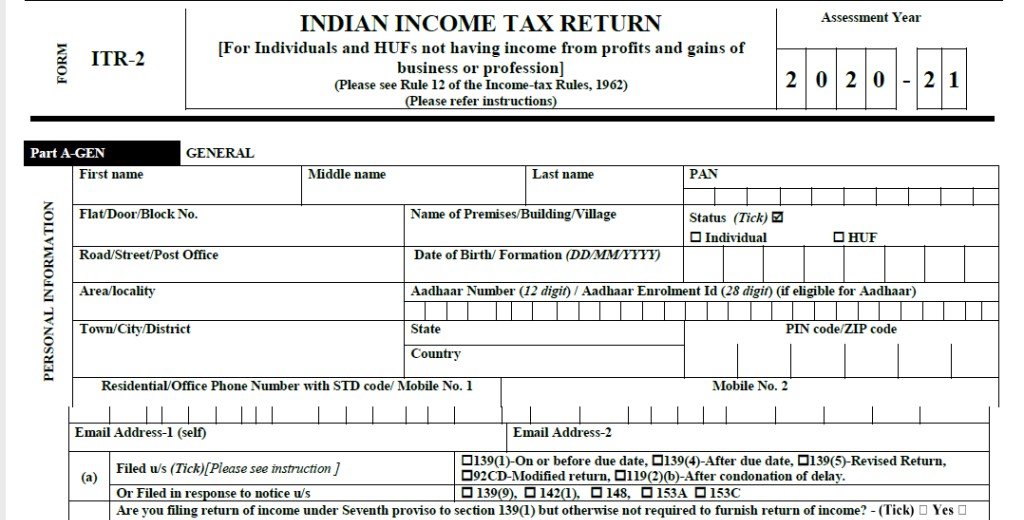
Purpose of ITR-2 in Indian Income Tax
The ITR-2 ensures accurate tax reporting when a taxpayer has:
- Capital gains from investments or property
- Multiple house properties
- Foreign income or assets
- High total income (over ₹50 lakh)
- Income from Virtual Digital Assets (VDAs)
This form helps the Income Tax Department assess an individual’s full tax liability, ensuring compliance in cases where ITR-1 falls short.
Who is Eligible for the ITR-2 Form?
This form is mandatory for individuals and HUFs who meet any of the following criteria:
- Income from Capital Gains: This is a primary reason for using ITR-2. If you have earned income from selling shares, mutual funds, property, or any other capital asset, you must file this form.
- Income from More than One House Property: Unlike ITR-1, ITR-2 is used if you have rental income from two or more properties, or have a combination of self-occupied and rented properties.
- Foreign Income or Assets: If you are a resident in India and have any foreign income or hold any foreign assets, you are required to file ITR-2.
- Company Director or Unlisted Shares: If you have been a director in any company or have held unlisted equity shares at any time during the financial year, ITR-2 is mandatory.
- Agricultural Income: If your agricultural income exceeds ₹5,000, you must use this form.
- Other Income Sources: This includes income from sources like lottery winnings, gambling, horse races, or income from VDAs such as cryptocurrencies and NFTs.
- Total Income Exceeds ₹50 Lakh: If your total income for the financial year is more than ₹50 lakh, you are required to file ITR-2.
- Non-Residents or RNORs: Individuals who qualify as Non-Resident Indians (NRIs) or Resident but Not Ordinarily Resident (RNOR) should file ITR-2 if they meet the income criteria. ITR-1 is only for residents.
- Clubbing of Complex Income: If the income of a spouse/minor is clubbed and includes capital gains or foreign income.
- Carrying Forward Capital Losses: This form is required if you are carrying forward capital losses from previous years to set them off against your current year’s income.
ITR-2 vs. ITR-1 (Sahaj): Key Differences for Salaried Individuals
Salaried individuals often choose between ITR-1 and ITR-2. While both forms support salary income, ITR-2 is used when the taxpayer has additional sources of income or needs to make specific disclosures not supported by ITR-1.
| Criteria | ITR-1 (Sahaj) | ITR-2 |
|---|---|---|
| Total income limit | Up to ₹50 lakh | No upper limit |
| Capital gains income | Not allowed | Mandatory if applicable |
| House property | One property only | More than one allowed |
| Foreign income or assets | Not permitted | Must file ITR-2 |
| Unlisted equity shares | Not supported | Disclosure required |
| Company directorship | Not applicable | Mandatory to use ITR-2 |
| Agricultural income | Up to ₹5,000 only | Over ₹5,000 allowed |
| Residential status | Resident (Ordinary) only, RNOR and NRI not eligible | RNOR and Non-Residents included |
| Virtual Digital Assets (VDAs) | Not supported | Reporting required |
ITR-2 vs. ITR-3: When Capital Gains Aren't Enough to Use ITR-2
While ITR-2 handles non-business income like salary, capital gains, and foreign assets, it cannot be used if you have any business or professional income. In such cases, even if you have capital gains, you must switch to ITR-3.
| Criteria | ITR-2 | ITR-3 |
|---|---|---|
| Business or professional income | Not allowed | Mandatory if applicable |
| Capital gains | Fully supported | Fully supported |
| Director in a company | Allowed | Allowed |
| Unlisted equity shares | Allowed | Allowed |
| Foreign income or assets | Allowed | Allowed |
| Partner in a firm (e.g., LLP) | Not allowed | ITR-3 required |
| Freelancing / consulting income | Not allowed | Fully supported |
| Schedule BP (Business income) | Not applicable | Mandatory for business income |
| Virtual Digital Assets (VDAs / crypto / NFTs) | Allowed (if no business income) | Mandatory if business activity is related to VDAs |
Note: If you receive even minor business income such as freelancing fees, consulting charges, or a share of profit from a partnership firm, ITR-3 becomes compulsory, regardless of any other income from capital gains or salary.
Who is Not Eligible to File the ITR-2 Form?
While the ITR-2 form covers a wide range of income types, there are specific situations where it cannot be used. Taxpayers falling under these categories must use a more appropriate form, such as ITR-3.
a. The Business or Profession Income Exclusion
The ITR-2 form cannot be used by individuals or HUFs earning income from business or profession. This includes:
- Income from freelancing, consulting, or technical services
- Income from speculative or non-speculative trading
- Income under Section 44ADA, 44AD, or 44AE (presumptive taxation)
- Self-employed professionals (doctors, lawyers, architects, etc.)
Even if the business income is nominal or part-time, the taxpayer must use ITR-3, which includes Schedule BP (Business and Profession) for accurate reporting.
b. Income from a Partnership Firm
Individuals who are partners in a partnership firm or LLP cannot file ITR-2 if they receive:
- Share of profit from the firm (exempt under Section 10(2A))
- Remuneration or interest from the firm (taxable under “business or profession”)
Such income is considered business income, and hence, ITR-3 becomes mandatory in these cases. ITR-2 does not support the reporting of partnership firm income or related schedules.
How to Fill the ITR-2 Form Online?
The process of filing Form ITR 2 is designed to be user-friendly on the income tax e-filing portal.
1. Prerequisites Before You Start Filing
Before initiating the filing process, ensure the following documents and data are readily available:
- Permanent Account Number (PAN) and Aadhaar number
- Bank account details, including IFSC code
- Form 16 issued by your employer
- Form 26AS, Annual Information Statement (AIS), and Taxpayer Information Summary (TIS)
- Capital gains computation statements for listed securities, mutual funds, and property
- Details of house properties, including rental income, municipal taxes, and interest on home loans
- Information related to foreign income or assets (if applicable)
- Records of income from VDAs, such as cryptocurrencies or NFTs
- Details of any advance tax or self-assessment tax paid
2. Logging into the Income Tax Portal and Selecting the ITR-2 Form
Visit the official Income Tax e-filing portal at incometax.gov.in. Log in using your PAN, password, and captcha, or use Aadhaar OTP or net banking for secure access.
The portal now automatically pre-fills data like Form 26AS, AIS, TIS, etc., in the ITR-2 form to simplify your filing process.
Once logged in:
- Go to e-File > Income Tax Returns > File Income Tax Return
- Select the appropriate Assessment Year
- Choose ‘Online’ as the filing mode
- Select the user type: Individual or HUF
- From the list of ITR forms, select ITR-2
Now you can easily download the ITR 2 form PDF from the portal.
3. Navigating the Pre-filled Data: Verification and Editing
The portal auto-populates data from your Form 26AS, AIS, and TIS. This includes:
- TDS deducted by employers and other deductors
- Bank interest income
- Dividend income
- Capital gains from listed securities
Each field must be thoroughly verified. If discrepancies exist, corrections should be manually made to ensure data integrity.
4. Filling Your Income Details: Salary, House Property, and Other Sources
Enter income details in the relevant schedules:
- Schedule S: Provide salary and pension details, based on Form 16
- Schedule HP: Report rental income, self-occupied property, interest paid on housing loans, and municipal taxes
- Schedule OS: Disclose income from dividends, savings interest, fixed deposits, lotteries, or VDAs
Ensure that all deductions under Chapter VI-A (Sections 80C to 80U) are correctly claimed.
5. Reporting Capital Gains Accurately
Use Schedule CG to report all capital gains:
- Provide ISIN, scrip name, acquisition and sale dates, and sale consideration
- Use the indexed cost of acquisition where eligible
- Enter exemptions claimed under Section 54, 54EC, 54F, etc.
- If multiple transactions exist, you may upload a CSV template provided by the portal for bulk entry
Maintain accuracy, as errors in capital gains computation can lead to notices or defective returns.
6. Completing the Filing: Tax Payment and Submission
After all income schedules are filled:
- The system computes the total tax liability or the refund amount
- If additional tax is due, pay via Challan 280 under self-assessment tax
- Review all schedules thoroughly and ensure data consistency
- Click ‘Proceed to Preview’ to generate a summary
- On confirmation, click ‘Submit’ to file the return
7. E-Verify Your ITR-2 Return
Post-submission, e-verification is compulsory for return validation. Choose from:
- Aadhaar OTP
- Net banking login
- Demat account verification
- Digital Signature Certificate (DSC)
- Bank ATM (offline method)
Note: E-verification must be completed within 30 days of filing the return. If not verified within this period, your ITR will be treated as invalid.
Documents Required for ITR-2 Filing
Filing ITR-2 requires a set of essential documents that support your income declarations, deductions, and tax payments. Organizing these documents beforehand ensures smooth and accurate filing.
Core Documents
- PAN Card: Mandatory for identification and filing your return.
- Aadhaar Card: Required for linking with PAN and for e-verification.
- Bank Account Details: Include account numbers and IFSC codes of all savings/current accounts where you receive income or refunds.
Income-Specific Documents
- Form 16: Issued by your employer, showing salary income and tax deducted at source.
- Rental Agreements and Property Documents: To substantiate income from house property.
- Capital Gains Statements: Brokerage statements, contract notes, or computation sheets showing sale and purchase details of shares, mutual funds, or property.
Proofs for Deductions: Your Key to Tax Savings
- Investment Proofs: LIC premiums, PPF, NSC certificates, and ELSS mutual funds under Section 80C.
- Medical Insurance Receipts: For deduction under Section 80D.
- Interest Paid on Housing Loan: Documents required under Section 24(b) and Section 80EE.
- Donations Receipts: For claiming deductions under Section 80G.
Key Documents for Reconciliation: Form 26AS, AIS, and TIS
- Form 26AS: Consolidates all TDS, TCS, and advance tax paid against your PAN.
- Annual Information Statement (AIS): Details financial transactions reported by third parties.
- Taxpayer Information Summary (TIS): Summarizes your tax credits and returns history.
Cross-check these to ensure all income and taxes are correctly reported and avoid mismatches during filing.
ITR-2 Form: A Detailed Breakdown of All Schedules
The ITR-2 form contains several schedules to capture specific details. Understanding each schedule is key to accurate ITR 2 form filling.
- Part A: Includes the taxpayer’s details, PAN, Aadhaar linking, residential status, and filing status (whether original or revised return).
- Schedule S: Used to report all income from salary or pension, including allowances and perquisites as per Form 16.
- Schedule HP: Declare income from one or more house properties. Include rent received, municipal taxes paid, and interest on housing loans.
- Schedule CG: Report gains or losses from selling assets like shares, mutual funds, or property. Provide dates of purchase and sale, cost details, and exemptions claimed.
- Schedule VDA (Virtual Digital Assets): For income from cryptocurrencies, NFTs, and other virtual digital assets as per tax laws.
- Schedule OS: Declare income such as bank interest, dividends, lottery winnings, and other miscellaneous sources.
- Schedule EI: Reports income that is exempt from tax, like agricultural income or exempt dividends.
- Schedule CYLA, BFLA, and CFL: Use these schedules to adjust current year losses, brought forward losses, and carry forward losses to future years. Covers losses from capital gains, house property, and others.
- Schedule VI-A and 80G: Claim deductions under Chapter VI-A, including investments (Section 80C), medical insurance (80D), and donations (80G).
- Schedule FA: Report foreign bank accounts, investments, income, and assets if you are a resident taxpayer with holdings abroad.
- Schedule AL: Disclose movable and immovable assets, investments, and liabilities of yourself, spouse, and dependent children. From FY 2024-25 onward, this disclosure is mandatory only if total income exceeds ₹1 crore. Earlier, it was required that the income exceeded ₹50 lakh. This threshold was increased from ₹50 lakh to ₹1 crore for the Assessment Year 2025-26, simplifying compliance for many taxpayers.
Tip: Refer to the Income Tax Department’s guidelines for the correct field names and formats when filling out schedules. (You can also use the pre-fill feature available on the e-filing portal.)
Common Mistakes to Avoid When Filing ITR-2
To ensure a smooth filing process and avoid penalties, be aware of these crucial points and common mistakes.
- Choosing the Wrong ITR Form: This is one of the most common and costly errors. A person with business income mistakenly filing ITR-2 instead of ITR-3 will receive a notice from the Income Tax Department.
- Errors in Reporting Capital Gains: The calculation of capital gains can be complex. Incorrectly reporting the purchase and sale values or the holding period can lead to a tax notice.
- Missing Details: Make sure to report all income sources, including small interest incomes from savings accounts. Reconcile your income with Form 26AS, AIS, and TIS to ensure all details are correctly reflected.
- Forgetting to e-Verify: Your ITR is considered invalid if you forget to e-verify it within the specified time limit (usually 30 days from the date of submission).
What is ITR-U?
If you realize you have made an error or omitted some income in a past year’s return, you can file an Updated Return (ITR-U) to correct it. This must be filed within 24 months of the end of the relevant assessment year.
- Due Date: The due date for filing ITR-2 for individuals is typically July 31st for the relevant Assessment Year. Missing this deadline can lead to a late filing fee of up to ₹5,000.
Connect with AccountingKaro and let our experts handle the legal hassle while you grow your business.
Frequently Asked Questions (FAQs)
Can a salaried person with share trading income file ITR-2?
Yes, if the share trading income is classified as capital gains, they can file ITR-2. If it is considered business income, they must file ITR-3.
What is the due date for filing ITR-2 for AY 2025-26?
The due date for filing ITR-2 for individuals (for whom audit is not applicable) for Assessment Year 2025-26 has been extended to September 15, from the original July 31.
Do I need to report all my bank accounts in ITR-2?
Yes, you must report all bank accounts held by you during the relevant financial year, except for dormant accounts.
How do I report losses from a previous year in ITR-2?
You can report losses from previous years in Schedule BFLA to set them off against current year income. Proper carry-forward of losses must be followed.
Can I file ITR-2 if I have income from a YouTube channel?
Income from a YouTube channel is typically considered ‘Income from Business or Profession,’ which requires filing ITR-3. This applies if you earn regularly from ads, sponsorships, or affiliate links. Only in very rare cases, such as a one-off viral video with no further activity, might it be considered ‘Income from Other Sources’ (ITR-2), but the standard and safer approach for creators is to file ITR-3.
What are the penalties for filing ITR-2 incorrectly or after the due date?
Late filing can attract a penalty of up to ₹5,000. Filing an incorrect return can lead to penalties and further legal action by the Income Tax Department.
Is it mandatory to file ITR-2 if my income is below the taxable limit, but I have foreign assets?
Yes, holding foreign assets makes it mandatory to file ITR-2 even if your total income is below the basic exemption limit.
Why Choose AccountingKaro to File ITR-2 Form?
Filing your ITR-2 can be tricky. AccountingKaro simplifies the ITR-2 filing process to ensure accuracy and timeliness. Here’s why many people trust us:
- Specialized in ITR-2: Perfect for salaried individuals, investors, and HUFs with income from salary, house property, or capital gains.
- Complete Support: We provide complete assistance, from document collection and return preparation to the final e-verification.
- Error-Free Returns: Returns are carefully reviewed to avoid mistakes, rejections, and notices.
- Timely Reminders: Alerts help ensure filing before deadlines to avoid penalties.
- Up-to-Date Knowledge: Keeps up with all the latest income tax portal updates and tax rules.

What Our Clients Say
S
Sanket Chawre
- Verified
Others
We had been struggling with many things during our LLP setup with RegisterKaro until Sonal stepped in as our compliance officer and overall liason. So…
Date Posted
2025-12-23
A
Ayusha Kumar
- Verified
Others
I had a great experience getting my company incorporated with the help of Ms. Anchal Gupta. She managed the entire process very efficiently and profes…
Date Posted
2025-12-23
P
Pradip Vernekar
- Verified
Others
I had an excellent experience with RegisterKaro. Atisha Jain and the team made the process of getting my GST certificate seamless and hassle-free. The…
Date Posted
2025-12-23
D
Dhariya
- Verified
Others
I recently had a great experience with RegisterKaro and their employee, Satyapriya Tripathi. They provided exceptional assistance with my professional…
Date Posted
2025-12-23
Latest Blogs

January 14,2026
What are CDSCO Guidelines for Medical Devices?
Joel Dsouza
Learn about CDSCO guidelines for medical devices in India. This guide covers classification, approval process, and compliance for manufacturers & importers.

January 14,2026
What are the Documents Required for a Trade License?
Srihari Dhondalay
Learn about the documents required for a trade license in India. This checklist covers key requirements, forms, renewal documents, and specific cases.

January 14,2026
How to Download the FSSAI Certificate Online? 2026 Guide
Joel Dsouza
Learn how to download an FSSAI certificate online using FOSCOS. This guide covers the process, license number method, and registration certificate steps.

January 14,2026
How to Get a Trade License for a Dental Clinic?
Srihari Dhondalay
Learn how to get a trade license for a dental clinic in India. Know the eligibility, process, and documents needed for clinic license registration.

January 14,2026
What is a Trade License? Eligibility, Types & Process
Joel Dsouza
Learn what a trade license is in India, its purpose, and key types. This article covers eligibility, fees, and the complete process to apply easily.

January 14,2026
Why is CDSCO Form 44 Important for New Drug Approval?
Joel Dsouza
Learn why CDSCO Form 44 is crucial for new drug approval in India. Explore its checklist, process, and documents needed for filing Form 44 with CDSCO.
Featured In