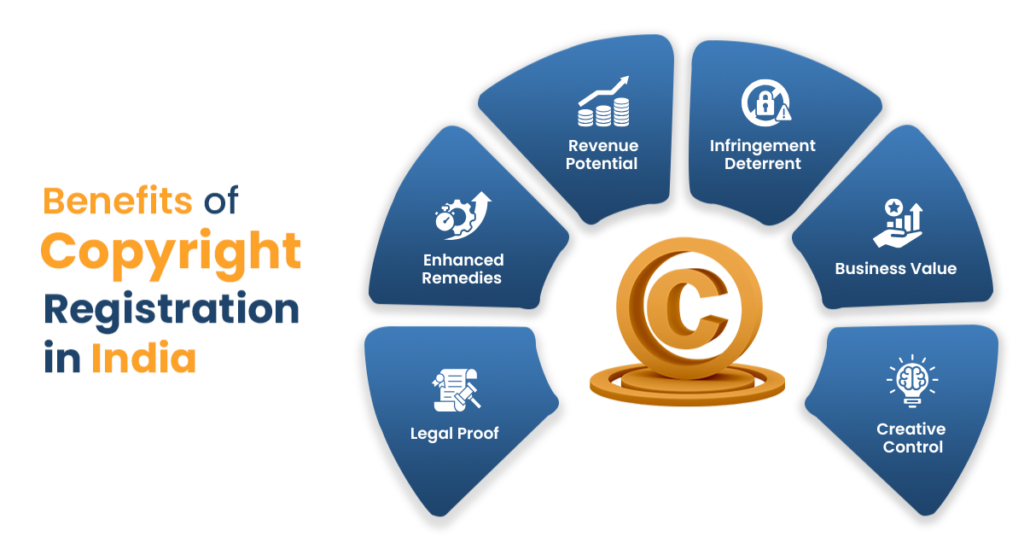
Registering your work is a powerful step to protect your creations. Here’s a summary of the key advantages:
- Legal Proof & Stronger Rights: A registration certificate is your official proof of ownership, recognized in court. It gives you stronger legal standing to stop infringement and simplifies legal disputes.
- Monetization & Business Value: Registration makes it easier to license your work for royalties, turning your creativity into an income source. It also makes your work more attractive to publishers, producers, and investors.
- Deters Unauthorized Use: A public registration warns others against copying your work. It also strengthens your case when requesting online platforms to take down pirated content.
- Preserves Creative Control: It gives you the legal authority to decide how your work is used, adapted, or modified, protecting your artistic vision.
Disadvantages of Copyright Registration
While beneficial, it’s good to be aware of the potential downsides:
- Time, Cost, and Complexity: The registration process isn’t instant; it can take several months. It involves government fees and potentially legal costs if you hire help. The paperwork can also be complex.
- Owner’s Responsibility: The Copyright Office doesn’t take responsibility for protecting your rights. You are responsible for finding and taking legal action against anyone who infringes on your work, which can be costly and time-consuming.
Eligibility Criteria for Copyright Registration
To qualify for Copyright Registration in India, the work must:
- Be original and creative with a minimum level of creativity
- Be fixed in a tangible medium of expression
- Fall within the categories protected under the Copyright Act
- Not merely an idea, procedure, process, system, method of operation, concept, principle, or discovery
- Not a work that has fallen into the public domain
Eligible applicants include:
- The original author or creator of the work.
- The legal owner who has acquired rights through assignment or transfer.
- Organizations or employers for work created during employment.
- Legal heirs or representatives of deceased authors.
Documents Required for Copyright Registration
A complete and accurate checklist for Copyright Registration is vital. Filing the required documents prevents delays.
Basic Documents for All Applications
- Completed Form XIV (application form)
- Power of Attorney (if filed through an agent)
- DD (Demand Draft)/IPO (Indian Postal Order)/online payment receipt for application fee
- Statement of particulars and further particulars
- Applicant’s identification proof (Aadhar/PAN/Passport)
- Address proof of the applicant
- Declaration of ownership and originality
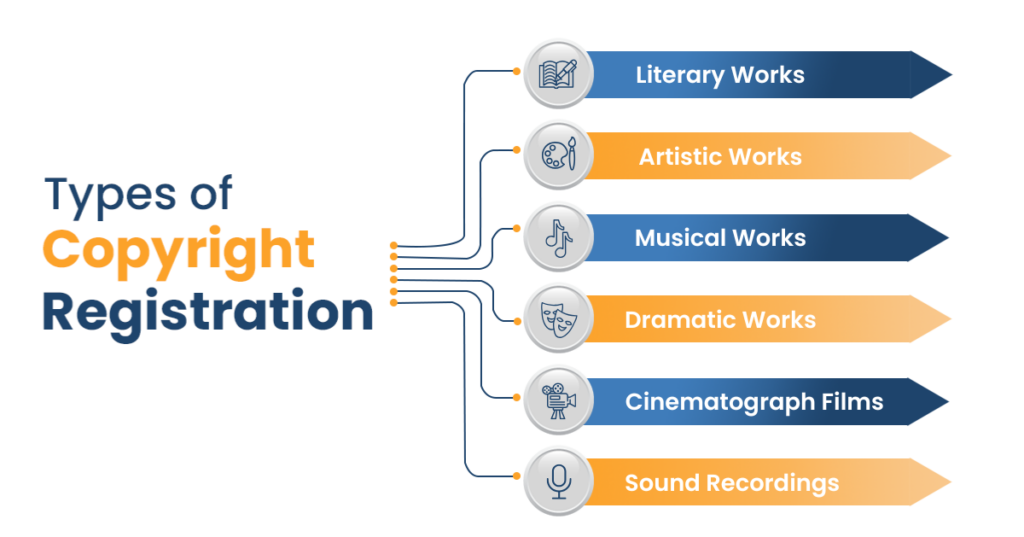
For Literary Works
- Two copies of the manuscript/published work
- Synopsis or extract of work (if complete work is voluminous)
- NOC from the publisher (if published)
- NOC from Co-authors or Contributors (if multiple people involved)
- Assignment deed (if the author is not the applicant)
- Evidence of first publication (for published works)
- Translation permission (if the work is a translation)
For Artistic Works
- Photographs or digital images of the artwork
- Description of the work, including dimensions, materials used
- Exhibition history (if applicable)
- Portfolio or catalog showing the work
- Certificate of authenticity (if available)
- Commission agreement (if work was commissioned)
- NOC from client/employer (if artwork was made under contract or commission)
For Musical Works
- Musical notation or score
- Audio recording (if available)
- Lyrics (if applicable)
- Collaboration agreements (if jointly created)
- Performance permissions (if it includes other artists)
- Publishing contracts (if commercially released)
For Cinematograph Films
- DVD/digital copy of the film
- Synopsis and credits
- Chain of title documents
- Agreements with performers and technicians
- Distribution agreements (if applicable)
- Censorship certificate (if commercially released in India)
For Sound Recordings
- CD/digital copy of the recording
- Details of performers and the recording process
- Agreement with performers
- Studio recording documentation
- Mixing and mastering information
- Composer/Lyricist NOC or Contracts (if third-party content was used)
- Release information (if commercially available)
Additional Documents for Specific Cases
- For software: Portions of source code and object code
- For foreign works: Evidence of first publication
- For posthumous works: Death certificate of the author and heir documents
- For joint authorship: No-objection certificates from all authors
- For work created during employment: Employment contract or NOC from employer
- For work made for hire: Contract detailing copyright ownership
How to Register Copyright in India: Step-by-Step Process
Here’s how you can register your copyright in India:
Step 1: Identify & Prepare Your Work
Determine the appropriate classification for your work and gather all required documents, including proof of identity, copies of your work, and completed Form XIV.
- Ensure your work is original and eligible for copyright protection.
- Calculate and prepare payment for the applicable registration fees.
Step 2: Create Your Application
Register on the copyright e-filing portal (Copyright Office) for online filing or prepare physical documents for submission to the Copyright Office in New Delhi.
- Fill out all forms accurately and completely.
- Organize supporting documentation in the required format.
Step 3: Submit Your Application
Complete the submission process either through the online portal (recommended) or by physical submission to the Copyright Office.
- Pay the required fees for Copyright Registration.
- Retain your acknowledgment receipt and diary number for tracking.
Step 4: Application Examination
Your application undergoes scrutiny for completeness and compliance with copyright regulations.
- Respond promptly to any objections or clarification requests.
- Monitor your application status using your diary number.
Step 5: Publication & Opposition Period
Application details are published in the Copyright Office Journal, followed by a 30-day window for third-party objections.
- Address any concerns raised during the opposition period.
- Provide additional documentation if requested.
Step 6: Registration Certificate Issuance
After successful verification and completion of the opposition period, the Copyright Office issues your registration certificate. The certificate is now digitally signed and available online as a PDF, and your copyright is entered into the Register of Copyrights as a public record.
Copyright Registration Fees & Penalties
Understanding the official costs and legal consequences is key to protecting your work effectively.
Registration Costs
The official government fees for Copyright Registration in India are statutory and paid directly to the Copyright Office. The current rates are as follows:
- Literary, Dramatic, Musical or Artistic Work: Rs. 500 per work.
- Artistic Work (used for goods): Rs. 2,000 per work.
- Cinematograph Film: Rs. 5,000 per work.
- Sound Recording: Rs. 2,000 per work.
- Software (a type of literary work): Rs. 500 per work (as it is treated as a literary work).
Note: These government fees do not include professional charges for services from a lawyer or filing agent.
Penalties for Infringement
Infringement of copyright is a serious offense under the Copyright Act, 1957, and carries both civil and criminal penalties, including:
- Court Injunctions: An immediate court order to stop the infringing activity and prevent further unauthorized use of the work.
- Monetary Damages: The court can order the infringer to pay damages, which may be calculated based on the profits they made or the financial losses suffered by the copyright owner.
- Criminal Charges: Under Section 63 of the Act, copyright infringement is a criminal offense punishable by imprisonment for a term of six months to three years and a fine of Rs. 50,000 to Rs. 2 lakhs.
Copyright Registration Timeline & Validity
Registration is a one-time process that provides extensive, long-lasting protection for creative works.
Registration Timeline
The Copyright Registration process in India generally takes 8-12 months to complete from the date of filing, assuming no objections or discrepancies arise.
This timeline includes a mandatory 30-day waiting period for any third-party objections, followed by an examination of the application by the Registrar. If an objection is filed, the process can take longer as it may require hearings to resolve the dispute.
Validity Period
The validity of Copyright Registration is long-term, ensuring protection for creators and their heirs. The duration depends on the type of work:
- For most works (Literary, Artistic, Musical, Dramatic): The protection lasts for the entire lifetime of the author plus an additional 60 years after their death.
- For films, sound recordings, photographs, and government works: The protection term is a fixed period of 60 years, which is counted from the beginning of the calendar year following the work’s first publication.
Copyright Registration Renewal & Cancellation
Once granted, copyright protection is final for its term, but the registration itself can be challenged under specific conditions.
Renewal Process
Unlike other forms of intellectual property that require periodic renewal, copyright registration does not require renewal and remains valid for the full term. The protection is granted for the full term automatically upon registration and does not need to be maintained with periodic fees or renewal applications.
Cancellation
A Copyright Registration can be challenged and cancelled even after it has been granted. Here’s how:
- A registration can be challenged and cancelled through a legal petition to a court.
- Cancellation can occur if the registration was obtained by fraud or misrepresentation.
- It may also be cancelled if the person who registered it was not the true owner.
- A registration can be revoked if it is found to be against the public interest.
Copyright Infringement and Legal Remedies
According to Section 51 of the Indian Copyright Act, 1957, copyright infringement occurs when someone uses or copies a copyrighted work without the permission of the owner. This includes unauthorized reproduction, distribution, or public display of the work.
Examples of Infringement: Common cases include illegally copying books, software, music, or movies, as well as selling fake or pirated versions of these works.
Permitted Uses (Exceptions)
Section 52 of the Indian Copyright Act outlines specific exceptions where copyrighted material can be used without prior permission. These permitted uses fall under the principle of “fair dealing” and include:
- Private or personal use, including research or study: Non-commercial use by individuals for learning or academic research.
- Criticism or review: Using copyrighted content to analyze or comment on it.
- Reporting current events or news: Use of content for journalistic or news-reporting purposes.
- Educational use by teachers or students: Reproduction and use for teaching or academic instruction.
- Judicial proceedings or legal advice: Use in court cases or by legal professionals.
- Use by libraries and archives: For preservation, research, or educational access.
These exceptions aim to balance the rights of copyright holders with the public interest in education, information, and expression.
Impact of Infringement
Unauthorized use of copyrighted material causes financial harm to the creator and discourages innovation. It also violates the creator’s moral rights, affecting their control over the work.
Legal Remedies for Infringement
Under Section 55, copyright holders can take civil legal action to:
- Obtain an injunction that orders the infringer to stop using the work immediately,
- Claim monetary damages to recover losses suffered,
- Demand an account of profits to claim any earnings made by the infringer from the unauthorized use.
Criminal Consequences
- For severe cases, Section 63 imposes criminal penalties such as fines and imprisonment.
- Special provisions under Section 63A protect digital works and provide specific penalties for online infringement.
How to Secure Your Rights: Registering your creative work with the Copyright Office helps establish your ownership legally, making it easier to enforce your rights if infringement happens.
Importance of Taking Legal Action: Prompt legal action helps protect your creative work, prevents further unauthorized use, and ensures you receive fair compensation for your efforts.
Difference Between Copyright, Trademarks, and Patents
Understanding the distinction between these core intellectual property rights is vital to avoid confusion, as they are separate intellectual rights that protect different works.
How to Check the Status of Your Copyright Application?
Want to track your copyright registration progress? Here’s how you can easily check the status of your application online:
- Go to the official Indian Copyright Office website (copyright.gov.in).
- Find the link for “Status of Application”.
- Enter the Diary Number you received when you filed.
- The current Copyright Registration status of your application will be displayed.
Copyright Registration Certificate
This certificate is the official proof that your work is protected under copyright law in India. It grants you formal recognition as the creator and gives you exclusive rights under the Copyright Act to reproduce, distribute, display, perform, and license your work.
With this certificate, you can legally prevent unauthorized use or copying of your creation and leverage your copyright for commercial purposes such as partnerships, publishing, or licensing deals. Copyright protection generally lasts for the lifetime of the author plus 60 years, depending on the nature of the work. Additionally, this certificate officially recognizes your work as a valuable intellectual property asset that can be sold, inherited, or transferred.
How to Download the Copyright Registration Certificate?
Here’s how you can download your copyright registration certificate:
- Go to the official website of the Indian Copyright Office: copyright.gov.in.
- Sign in using your registered user ID and password.
- Find the section for “Application Status” or “Registered Works.”
- Locate your registered work and select it.
- Click on the option to download the copyright certificate.
- Save or print the certificate for your personal records and future reference.
If you encounter any difficulties, reach out to the Copyright Office for support.