Private Limited Company Registration Online in India
- Company Registration in 7–10 Business Days
- Name Approval & MCA Filing by Experts
- PAN, TAN, DIN, DSC, MoA & AoA Included
- MCA-Approved Certificate of Incorporation
- Trusted by 25,000+ Startups & Entrepreneurs Across India
Enter your details to receive a full quote and consultation
By clicking, you consent to receiving updates about our services as outlined in our Privacy Statement.

4.6 out of 5

4.7 out of 5
What Sets Us Apart
500+ MCA Certified Experts
10,000+ Verified Reviews
2500+ Monthly Clients Onboardings
Serving Businesses Across India
Watch – How to Register a Private Limited Company Online
Tired of confusing paperwork and endless formalities? AccountingKaro makes Pvt Ltd Company Registration online simple and fully guided. Our experts manage every step, from documentation to incorporation, while you focus on growing your business.
Watch how easily you can register your Private Limited Company with AccountingKaro, from filling out documents to receiving your incorporation certificate.
Still have questions?
What is Company Registration?
Company registration in India is the legal process of bringing a business entity into existence under the Companies Act, 2013. It involves formally registering your business with the Ministry of Corporate Affairs (MCA) to obtain a unique identity and legal recognition. Once registered, the business becomes a separate legal entity, i.e., capable of owning assets, entering into contracts, borrowing funds, and being sued or suing in its own name.
The Act defines various company structures that an entrepreneur can choose based on their needs, such as:
- Private Limited Company (Pvt Ltd)
- Public Limited Company
- One Person Company (OPC)
- Limited Liability Partnership (LLP)
- Section 8 Company (Non-profit organization)
Among these, understanding what a Private Limited Company is becomes crucial, as it remains the most preferred form of company registration in India.
What is a Private Limited Company?
A Private Limited Company (aka Pvt. Ltd. Company) is a separate legal entity that is privately held by a small group of people (shareholders). Unlike sole proprietorships or partnerships, the company’s liability is limited to the number of shares held by each shareholder, which means their personal assets are protected in case of business losses. It is one of the most popular business structures in India, especially for startups and growing businesses.
Key features of a Private Limited Company
- Ownership: Minimum 2 and maximum 200 members.
- Legal Identity: Recognized as a separate entity under the Companies Act, 2013.
- Limited Liability: Shareholders are liable only up to their shareholding.
- Continuity: Business continues to exist even if shareholders change.
- Credibility: Preferred structure for investors, banks, and venture capitalists.
In simple terms, a Private Limited Company provides the professional credibility of a corporate structure while ensuring flexibility and limited risk for its owners, making it an ideal choice for entrepreneurs aiming to grow and scale.
What is Pvt Ltd Company Registration?
Pvt Ltd Company Registration formally incorporates your business under the Companies Act, 2013. It separates your assets from business risks and helps attract investors.
This type of company is ideal for startups, growing businesses, and anyone planning to raise capital. A Private Limited Company must have at least two directors and two shareholders to begin.
Laws Governing Private Limited Company Registration in India
Private limited company registration in India is primarily governed by the following laws and regulations:
- Companies Act, 2013: The primary legislation governing all aspects of company formation, operation, dissolution, and corporate governance standards.
- Income Tax Act, 1961: Regulates the taxation aspects of private limited companies, including corporate tax rates, deductions, and filing obligations.
- Goods and Services Tax (GST) Laws: Mandatory GST registration is required for companies crossing specified turnover thresholds.
- Foreign Exchange Management Act (FEMA): Controls foreign investment in Indian companies and regulates overseas operations.
- Securities and Exchange Board of India (SEBI) Regulations: Governs securities issuance and trading, particularly relevant for companies planning to raise capital.
- Information Technology Act, 2000: Applies to companies engaging in electronic commerce and digital business activities.
Regulatory Authorities
To establish and operate your company legally, the key regulatory authorities you will interact with include:
- Registrar of Companies (ROC): Under the Ministry of Corporate Affairs, the ROC processes your SPICe + application and issues the Certificate of Incorporation.
- Income Tax Department: Manages corporate tax filings.
- Reserve Bank of India (RBI) (if you have foreign investment): It regulates Foreign Direct Investment approvals, external commercial borrowings, and repatriation of dividends under FEMA.
Types of Private Limited Companies
While most entrepreneurs focus on forming a Company Limited by Shares, it’s important to understand the broader categories of Private Limited Companies in India. The key difference among these types lies in the extent of members’ liability in case of company losses or dissolution — essentially, how much members are responsible for if the company faces losses or shuts down.
1. Company Limited by Shares
In this type, the liability of each shareholder is limited to the unpaid amount on their shares. If the shares are fully paid, there’s no further liability.
Example: Reliance Industries Limited shareholders are only responsible for any unpaid share amount.
2. Company Limited by Guarantee
Members agree to pay a certain amount if the company closes down. This amount is mentioned in the Memorandum of Association (MOA). It is usually used for non-profit organizations.
Example: Indian Olympic Association members guarantee a fixed sum only if the company is dissolved.
3. Unlimited Company
Members have no limit on their liability. If the company cannot pay its debts, members may have to use their funds. Still, the company has its own legal identity, so members are not sued directly.
Example: Some family-owned businesses choose this structure for more control and privacy.
Eligibility Criteria for Private Limited Company Registration
To successfully register a Private Limited Company in India, you must meet the following eligibility criteria:
- A company must have at least two directors to be eligible for registration.
- Out of all the directors, at least one must be an Indian resident, meaning they must have stayed in India for 182 days or more in the previous financial year.
- A Private Limited Company can have up to 15 directors by default. However, this number can be increased beyond 15 by passing a special resolution with shareholder approval.
- At least two shareholders are required to incorporate the company. The same individuals can also act as directors.
- The total number of shareholders is limited to 200, excluding current and former employees holding shares under an employee stock option or similar plan.
- Registered Office: The company must have a physical registered office in India. This address will be used for all official government communication and must be supported by address proof and a No Objection Certificate (NOC) from the property owner if rented. You can read our detailed guide on how to get NOC for a business address to understand the process and document requirements.
- Company Name: Before proceeding with registration, it’s crucial to choose a unique and compliant company name as per MCA guidelines. It’s crucial to properly understand the steps to choose a name for your private limited company before registering.
- There is no minimum paid-up capital requirement. However, the company must declare its authorized share capital, for which a government fee is applicable during registration.
- Every director must obtain a Director Identification Number (DIN), which is issued by the Ministry of Corporate Affairs (MCA).
- All proposed directors are required to obtain a Class 3 Digital Signature Certificate (DSC). It is used for digitally signing incorporation documents during the registration process.
Eligibility for company registration in India may depend on the business structure, region, and authorities’ requirements. It’s crucial to check once before jumping to the documentation stage.
Documents Required for Pvt Ltd Company Registration
Before registering a company in India, it’s important to gather all the necessary Pvt Ltd company registration documents for a smooth process. These documents primarily include identification and address proofs of directors and shareholders, along with registered office details. Submitting accurate and valid paperwork helps avoid delays and ensures compliance with MCA regulations.
For Directors and Shareholders (Indian Nationals)
- PAN Card (Mandatory)
- Aadhar Card
- Recent passport-sized photographs
- ID & Address Proofs (any one): Latest Residential Utility bill (electricity, gas, telecom, not older than 2 months), or Bank statement (not older than 2 months), or Driver’s License/Voter ID card.
- Email ID & Mobile Number (linked with Aadhaar preferred)
- Specimen signature
For Foreign Directors/Shareholders (Additional Documents)
- Copy of passport (with visa details, if applicable)
- Address Proof from Home Country (e.g., utility bill, bank statement, driving license)
- Bank Statement from Home Country
- All foreign documents must be Notarized and Apostilled/Consularized as per international legal requirements.
For the Registered Office Address
- Proof of Address: Latest Utility Bill (electricity, gas, telecom, not older than 2 months) or Property Tax Receipt.
- No Objection Certificate (NOC): From the property owner if the premises are rented/leased.
- Rent/Lease Agreement Copy: (if applicable)
Company-Related Documents & Information
- Proposed Company Name Options (3-4 alternatives, in order of preference)
- Detailed Description of Business Activities and Objectives
- Details of Authorized and Paid-up Capital
- Shareholding Pattern (who holds how many shares)
- Draft Memorandum of Association (MOA)
- Draft Articles of Association (AOA)
- Resolution Appointing First Directors
Different regions might require additional documents for company registration as per MCA guidelines. Ensure to prepare a detailed checklist while planning for registration.
Document Formats for Pvt Company Registration (Download PDFs)
| Documents | File (PDF) | Documents | File (PDF) |
|---|---|---|---|
| SPICe+ Part A | Download | NOC for Company Address | Download |
| SPICe+ Part B | Download | Memorandum of Association (MoA) | Download |
| Agile Pro | Download | Articles of Association (AoA) | Download |
| INC 9 | Download | Certificate of Incorporation | Download |
| DIR 2 (Consent to act as director) | Download | E-PAN | Download |
| Specimen Signature (EPF) | Download | E-TAN | Download |
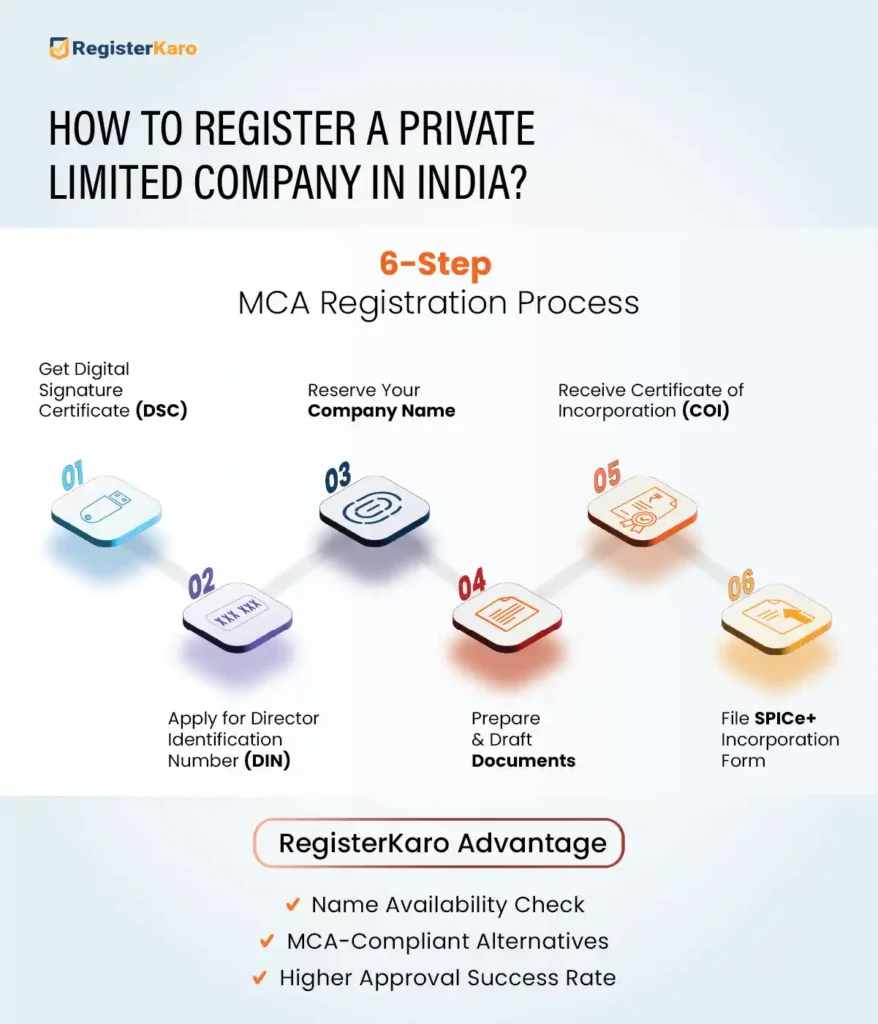
How to Register a Private Limited Company in India?
The process of registering a Private Limited Company in India can seem complex. To simplify it, here’s a step-by-step guide on how to register your company with the MCA.
The process involves obtaining a Digital Signature Certificate (DSC) and Director Identification Number (DIN), reserving a unique company name, and filing the integrated SPICe+ form for incorporation. This single application also takes care of statutory registrations such as PAN, TAN, EPFO, and ESIC, ensuring a smooth, one-window setup for your business.
Step 1: Get Digital Signature Certificates (DSC)
Each proposed director and subscriber to the Memorandum of Association (MOA) must obtain a Class 3 DSC. This is used to sign documents for a paperless registration process digitally.
- Validity: 2 years
- Cost: Rs. 1,000 – Rs. 2,000 (varies by certifying authority)
- Recommended Providers: eMudhra, NIC, or other MCA-recognized agencies.
Step 2: Apply for Director Identification Number (DIN)
Every director must have a unique DIN. For new companies, DINs are issued as part of the SPICe+ incorporation form, so a separate application is not needed.
- DIN is valid for life and remains the same even if the director changes companies.
- Foreign nationals can also apply using a passport and proof of overseas address.
Step 3: Reserve Your Unique Company Name
Use the RUN (Reserve Unique Name) service on the MCA portal to request your preferred company name. You can submit up to 4 name options.
Naming Guidelines:
- The name must be unique and not identical to existing companies
- Should follow MCA naming rules and not include restricted words
- Approval Time is usually 1–2 working days
- Approved names are reserved for 20 days
If rejected, you can reapply immediately with alternate name options.
Our Advantage: We conduct a thorough company name availability search to maximize your approval chances and suggest robust alternatives if needed.
Step 4: Prepare & Draft Essential Documents
This crucial step involves drafting and finalizing key legal documents. Our team of CAs & Lawyers ensures accurate legal drafting of:
- A Memorandum of Association (MOA) defines the company’s main objectives.
- Articles of Association (AOA) set rules for internal management.
- Director Declaration of Consent
- Registered Office Proofs: Rent agreement, utility bill, and NOC from the property owner
All documents must be formatted as per MCA rules and digitally signed by the concerned parties.
Step 5: File the Incorporation Form (SPICe+)
We prepare and submit the comprehensive SPICe+ form online on your behalf, along with all required documents. Pay the applicable government fees, based on your company’s authorized capital.
This single form covers:
- Company registration
- PAN & TAN allotment
- EPFO & ESIC registration
- Bank account opening
Ensure all files are in PDF format, and cross-check director details to avoid rejection.
Step 6: Receive Your Official Certificate of Incorporation (COI)
Upon successful verification by the Registrar of Companies (ROC), you will be issued the Certificate of Incorporation (COI). This pivotal document legally confirms your company’s formation and includes:
- Your unique Corporate Identity Number (CIN)
- Your company’s PAN (Permanent Account Number)
- Your company’s TAN (Tax Deduction and Collection Account Number)
At RegisterKaro, we aim to complete the process within 7–10 working days for standard applications, provided all documents are accurate, and government authorities respond promptly. Once your COI is received, your business is legally ready to commence operations and open its corporate bank account!
The timeline may extend based on different factors. Read the guide on How Long Does It Take to Register a Company for more information.
Private Limited Company Registration Certificate
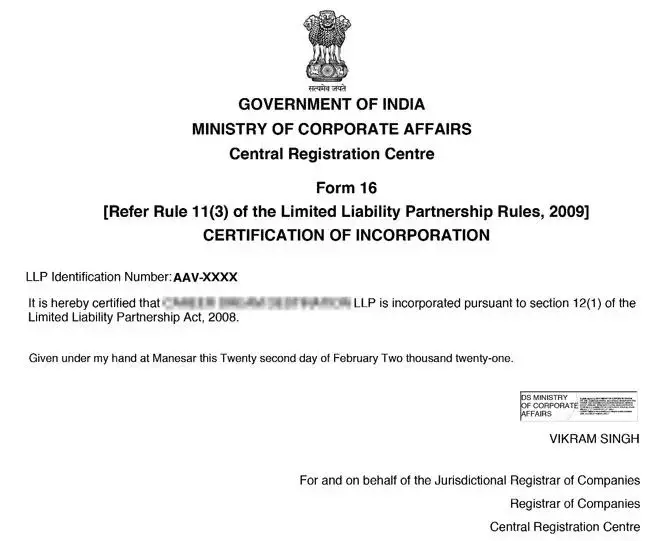
Once your Private Limited Company gets registered with the Ministry of Corporate Affairs (MCA), you receive a Certificate of Incorporation (COI). This certificate confirms the legal formation of your company under the Companies Act, 2013.
The COI includes your company’s legal name, Corporate Identification Number (CIN), date of incorporation, and registered office details. It’s a crucial document that works as proof of company registration in India for your business.
You’ll need the COI for several business activities, such as:
- Opening a business bank account
- Registering for PAN, TAN, and GST
- Entering into legal contracts
- Applying for licenses and permits
- Seeking funding or attracting investors
Having a valid certificate of incorporation of a Private Limited Company builds trust with customers, government authorities, and potential partners.
How to Get a Registration Number for a Private Limited Company?
After registering with the MCA, you will receive a Certificate of Incorporation. This certificate includes your Corporate Identification Number (CIN), which serves as the official registration number of your Private Limited Company.
Steps to Get a Private Limited Company Registration Number:
- Get DSC and DIN: Apply for a Digital Signature Certificate and Director Identification Number for all proposed directors.
- Choose and Approve a Company Name: Submit your name choice to MCA through the SPICe+ or RUN form.
- Fill and submit the SPICe+ Form: Provide company details like business address, directors, and capital.
- MCA Reviews Your Application: The government verifies the documents and details.
- Receive Your Certificate of Incorporation: Once approved, the MCA issues the certificate along with your CIN.
Your CIN is used in all legal, tax, and compliance matters. It is also needed for opening a company bank account, filing GST, or submitting annual returns.
How to Download the Certificate of Private Limited Company Incorporation?
If you need a digital copy of your company’s Certificate of Incorporation, here’s how to get it:
- Visit the MCA Portal: Go to mca.gov.in.
- Log in to your account: Use your registered username and password (Business User account).
- Go to the ‘MCA Services’ section: Click on “Get Certified Copies” or “View Public Documents.”
- Search for your company: Enter your company’s CIN or full name to locate it.
- Pay the applicable fee (if any): Some documents may have a nominal fee for download.
- Download the COI: Once the document is ready, download the Certificate of Incorporation in PDF format.
- Keep it safe: Save the file and print a copy for your company records.
This certificate is often requested during audits, legal filings, or when applying for official approvals, so it’s important to have it readily accessible.
How to Check the Status of Private Limited Company Incorporation?
To check whether your Private Limited Company is registered in India, follow these simple steps:
- Visit the MCA website: Go to mca.gov.in.
- Access the Company Master Data: Click on “MCA Services” in the main menu, then select “View Company/LLP Master Data.”
- Enter company details: Type in your company’s name or Corporate Identification Number (CIN).
- Complete the CAPTCHA and submit: Enter the verification code and click “Submit.”
- Check the status: You’ll see key information such as the company’s registration number, date of incorporation, current status (active, inactive, etc.), and registered address.
If you run into any issues or need help, you can contact the MCA helpdesk or visit the local Registrar of Companies (RoC) office.
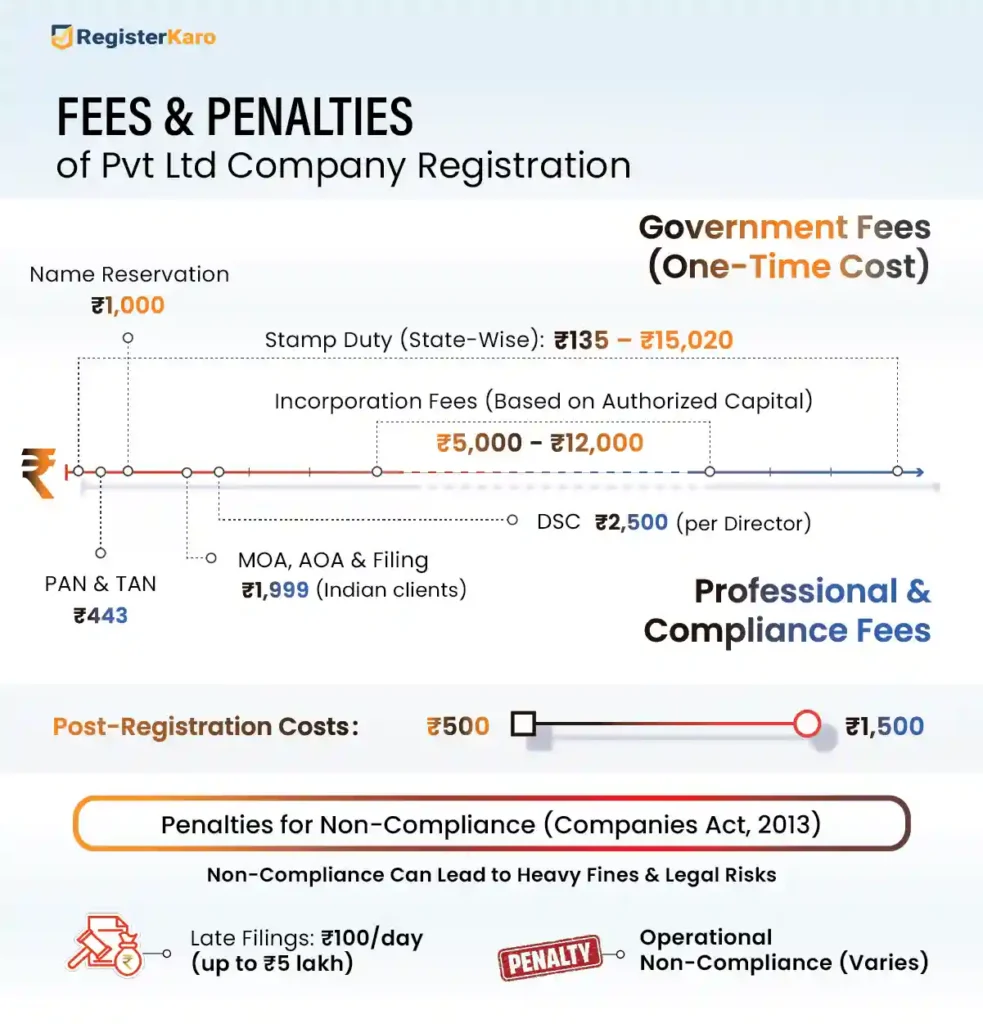
Fees and Penalties of Pvt Ltd Company Registration
The cost for incorporating a company varies depending on different factors, including company size, location, and legal requirements. Here’s a detailed breakdown of the Pvt. Ltd. company registration cost.
Registration Fees of a Private Limited Company
The fees for registration of a private limited company involve several components:
| Fee Category | Item | Cost/Range |
|---|---|---|
| Government Fees | ||
| Name reservation fee | Rs. 1,000 | |
| Incorporation fees |
- Up to Rs. 1 lakh: Rs. 5,000 - Rs. 1 lakh to Rs. 5 lakh: Rs. 5,000 + 0.01% - Rs. 5 lakh to Rs. 1 crore: Rs. 5,400 + 0.005% - Above Rs. 1 crore: Rs. 10,150 + 0.001% |
|
| Stamp duty | Varies by state (Rs. 135 – Rs. 15,020) | |
| Professional Fees | ||
| Digital Signature Certificate (DSC) | Rs. 2,500 per DSC | |
| Professional service charges (MOA, AOA, filing) | Rs. 1,999 (India clients), varies for NRI | |
| PAN & TAN Application Fee | Rs. 443 | |
| Post-Registration Costs | ||
| Company seal & stationery | Rs. 500 – Rs. 1,500 | |
| Bank account opening charges | Varies by bank | |
| GST registration (if applicable) | Government fees: Free + Professional fees | |
Note: Stamp duty charges and government fees for Private Company registration may vary depending on the company’s location and authorized capital. For complete details, check our comprehensive guide on Private Limited Company registration fees in India.
Penalties for Non-Compliance of a Private Limited Company
Failing to adhere to the statutory requirements of the Companies Act, 2013, can lead to substantial financial penalties and legal repercussions. Proactive compliance is key to avoiding these:
| Non-Compliance / Default | Form (if applicable) | Penalty Details |
|---|---|---|
| Delay in Annual Return | Form MGT-7 | Rs. 100 per day of delay. The maximum penalty can extend to Rs. 5 lakh for serious cases. |
| Delay in Financial Statements | Form AOC-4 | Rs. 100 per day of delay. The maximum penalty can extend to Rs. 5 lakh for serious cases. |
| Failure to hold a minimum of four board meetings | N/A | Rs. 25,000 for the company and Rs. 5,000 for every officer in default. |
| Non-maintenance of Statutory Registers | N/A | Penalty up to Rs. 10,000 and an additional Rs. 1,000 per day for continuing offense. |
| Failure to Update Company Changes | N/A | Rs. 500 to Rs. 5,000 per day of continuing default. |
| Non-Disclosure of Interest by Directors | N/A | Penalty Up to Rs. 1 lakh with Potential disqualification. |
| Non-Compliance with CSR Requirements | N/A | Company fined up to Rs.50,000; officers fined Rs.1,00,000 plus rs.5,000/day. |
Benefits of Pvt Ltd Company Registration in India
Registering your business as a Private Limited Company in India ensures legal protection, credibility, and long-term stability. It offers key benefits such as limited liability, tax advantages, perpetual succession, and recognition as a separate legal entity — making it one of the most trusted and growth-oriented business structures under Indian law.
Here’s why choosing a Pvt. Ltd. company is a smart decision:
1. Robust Legal Recognition, Protection & Funding Advantage
- Separate Legal Identity: The company is recognized as a separate legal entity. It can own property, enter into contracts, and initiate or face legal action in its name.
- Limited Liability: Shareholders are protected from personal liability. Their risk is limited to the amount invested in shares.
- Easier Access to Funding: Being a recognized corporate structure, a Private Limited Company is preferred by investors, venture capitalists, and banks, making it easier to raise funds and attract investment for business growth.
2. Enhanced Transparency & Credibility
- Builds Trust: Being a registered company improves your credibility with clients, suppliers, and financial institutions.
- Investor Confidence: Proper compliance and structured governance help attract serious investors.
3. Financial Advantages
- Easier Access to Loans: Banks and NBFCs prefer to offer loans to registered companies over unregistered entities.
- Equity Investment Ready: You can raise funds by offering shares to angel investors, venture capital firms, or strategic partners.
4. Operational Advantages
- Easy Transfer of Ownership: Shares can be transferred smoothly, making changes in ownership or investment simple under company law.
- Asset Transactions in Company Name: The company can own, buy, or sell assets directly. Transactions are backed by board resolutions, simplifying operations compared to sole ownership.
5. Growth Opportunities
- Eligible for Government Schemes: Registered companies can benefit from schemes under Startup India, MSME incentives, and various industry-specific policies.
- Strategic Partnerships Made Easier: Being a formal entity makes it easier to enter joint ventures, mergers, or partnerships.
6. Perpetual Succession
- Continues Beyond Owners: The company exists independently of the founders or shareholders.
- Supports Long-Term Vision: Helps create a legacy by carrying forward the founder’s goals and values, even after their exit.
Private company registration helps companies with taxation benefits a well. Check out how to save tax for private limited companies in India.
Disadvantages of Private Limited Company Registration
Registering your business as a Private Limited Company in India ensures legal protection, credibility, and long-term stability. It offers key benefits such as limited liability, tax advantages, perpetual succession, and recognition as a separate legal entity — making it one of the most trusted and growth-oriented business structures under Indian law.
Here’s why choosing a Pvt. Ltd. company is a smart decision:
1. Robust Legal Recognition, Protection & Funding Advantage
- Separate Legal Identity: The company is recognized as a separate legal entity. It can own property, enter into contracts, and initiate or face legal action in its name.
- Limited Liability: Shareholders are protected from personal liability. Their risk is limited to the amount invested in shares.
- Easier Access to Funding: Being a recognized corporate structure, a Private Limited Company is preferred by investors, venture capitalists, and banks, making it easier to raise funds and attract investment for business growth.
2. Enhanced Transparency & Credibility
- Builds Trust: Being a registered company improves your credibility with clients, suppliers, and financial institutions.
- Investor Confidence: Proper compliance and structured governance help attract serious investors.
3. Financial Advantages
- Easier Access to Loans: Banks and NBFCs prefer to offer loans to registered companies over unregistered entities.
- Equity Investment Ready: You can raise funds by offering shares to angel investors, venture capital firms, or strategic partners.
4. Operational Advantages
- Easy Transfer of Ownership: Shares can be transferred smoothly, making changes in ownership or investment simple under company law.
- Asset Transactions in Company Name: The company can own, buy, or sell assets directly. Transactions are backed by board resolutions, simplifying operations compared to sole ownership.
5. Growth Opportunities
- Eligible for Government Schemes: Registered companies can benefit from schemes under Startup India, MSME incentives, and various industry-specific policies.
- Strategic Partnerships Made Easier: Being a formal entity makes it easier to enter joint ventures, mergers, or partnerships.
6. Perpetual Succession
- Continues Beyond Owners: The company exists independently of the founders or shareholders.
- Supports Long-Term Vision: Helps create a legacy by carrying forward the founder’s goals and values, even after their exit.
Private company registration helps companies with taxation benefits a well. Check out how to save tax for private limited companies in India.
Post-Incorporation Compliance Requirements for a Private Limited Company
After registration, every Private Company in India must meet annual compliance requirements. From filing annual returns to holding board meetings, these compliances ensure legal protection and help avoid penalties or regulatory issues.
| Compliance Area | Details |
|---|---|
| Annual Filings | |
| Form MGT-7 (Annual Return) |
• File within 60 days of the AGM • Includes details of shareholders, directors, and shareholding changes |
| Form AOC-4 (Financial Statements) |
• File within 30 days of the AGM • Includes balance sheet, P&L, and cash flow • Must be signed by directors and certified by auditors |
| Board & General Meetings | |
| Board Meetings |
• First meeting within 30 days of incorporation • Minimum 4 meetings annually • Maintain proper notice and minutes |
| Annual General Meeting (AGM) |
• Within 6 months of the financial year-end • First AGM within 9 months of incorporation |
| Statutory Requirement | |
| Mandatory Registration |
• Register of Members • Register of Directors • Register of Charges • Minutes of Board and General Meetings |
| Taxation Compliance | |
| Income Tax |
• Annual ITR filing • Advance tax if applicable • Tax audit if turnover > Rs. 1 crore (or Rs. 5 crore for digital businesses) |
| GST (if applicable) |
• Monthly/quarterly GST returns • Annual return (GSTR-9) • E-way bill for goods movement |
| TDS (if applicable) |
• Deduct and deposit TDS on time • File quarterly TDS returns • Issue TDS certificates |
Ensure to check with professional experts like RegisterKaro for legal requirements. Start by checking out the TDS Compliance Checklist for Private Limited Companies.
Comparison Between Different Types of Company Registrations
Choosing the right business structure is essential, as it impacts liability, tax benefits, compliance, and investment opportunities. Below is a quick comparison to help you understand the key differences between popular company registration types in India:
| Feature | Private Limited Company | Limited Liability Partnership (LLP) | Sole Proprietorship | Partnership Firm | One Person Company (OPC) |
|---|---|---|---|---|---|
| Legal Status | Separate Legal Entity | Separate Legal Entity | No Separate Legal Entity | No Separate Legal Entity | Separate Legal Entity |
| Liability Protection | Limited to shares held | Limited to contribution | Unlimited liability | Unlimited liability | Limited to shares held |
| Minimum Members | 2 Directors, 2 Shareholders | 2 Partners | 1 Proprietor | 2 Partners | 1 Director, 1 Shareholder |
| Key Compliance | High (MCA filings & audits) | Moderate (MCA filings) | Low (Basic tax filings) | Moderate (Tax & RoF) | High (MCA filings) |
| Ideal For | Startups & Growth Companies | Professional Firms | Small Traders | Shared Ownership Businesses | Solo Entrepreneurs |
Connect with AccountingKaro and let our experts handle the legal hassle while you grow your business.
Frequently Asked Questions (FAQs)
Can a single person register a private limited company in India?
No, a single person cannot register a Private Limited Company in India. The law requires a minimum of two members — at least two directors and two shareholders — to form a private company. However, if you’re a solo entrepreneur, you can register a One Person Company instead, which allows a single individual to own and manage the business.
Is there a minimum capital requirement for private limited company registration?
No, there is no minimum capital requirement for Private Limited Company registration in India. You only need to declare an authorized share capital and pay the applicable fee. A common initial authorized capital for many new ventures is Rs 1 lakh, though there is no mandatory minimum.
How long does it take to complete private limited company registration in India?
It usually takes around 7–10 working days to complete Private Limited Company registration in India, provided all documents are correctly submitted. RegisterKaro ensures a smooth and timely registration process.
What documents are required for Private Limited Company registration?
Documents required for a Private Limited Company Registration are:
- Identity proof of all directors and shareholders (Aadhaar, Passport, PAN)
- Address proof of directors and shareholders (Passport, Voter ID, Utility bills)
- Passport-sized photographs of directors
- Proof of registered office address (rent agreement or ownership documents)
- No Objection Certificate (NOC) from the property owner (if rented)
- Digital Signature Certificate (DSC) and Director Identification Number (DIN)
What are the major differences between private limited company registration and LLP registration?
The main differences between a Private Limited Company and an LLP (Limited Liability Partnership) are:
- Fundraising: A Private limited company can issue shares; an LLP can’t.
- Compliance: Companies face more regulatory filings, while LLPs have simpler compliance.
- Liability: Both provide limited liability, but LLPs offer more operational flexibility.
Can I register a private limited company with a similar name to an existing business?
No, you cannot register a Private Limited Company with a name similar to an existing business. The Ministry of Corporate Affairs (MCA) requires company names to be unique. RegisterKaro conducts a detailed name availability search and suggests alternatives if required.
Is GST registration mandatory after private limited company registration?
GST registration is mandatory only if your Private Limited Company’s annual turnover exceeds ₹20 lakhs (₹10 lakhs for special category states) or if you supply goods or services across states.
What happens if my company doesn’t commence business after registration?
If your company doesn’t start business after registration, you must file Form INC-20A within 180 days of incorporation. Failure to do so attracts penalties. For prolonged inactivity, you can file Form MSC-1 for dormant status; otherwise, the ROC may strike off the company.
Can my private limited company convert to a public company later?
Yes, a Private Limited Company can be converted into a Public Limited Company by altering its MoA and AoA, increasing members to at least seven, complying with higher regulations, and obtaining NCLT approval.
What are the annual compliance requirements after private limited company registration?
A Private Limited Company must:
- File financial statements (AOC-4) and annual returns (MGT-7),
- Submit income-tax returns,
- Conduct board meetings and an AGM,
- Maintain statutory registers and follow industry-specific compliance.
Is a company seal mandatory after a private limited company registration?
No, a company seal is not mandatory for Private Limited Companies. The 2015 amendment made seals optional, although some banks and departments may still request one for document authentication.
What are the tax benefits of private limited company registration compared to other structures?
Tax benefits for Private Limited Companies include:
- A flat 25% corporate tax rate for turnover up to ₹400 crore.
- Eligibility for startup-related tax exemptions.
- Deduction claims are unavailable to sole proprietorships.
- Advanced tax-planning options for business reinvestment.
Can a private limited company apply for trademark registration?
Yes. To strengthen your brand, you should get Trademark Registration:
- File a trademark application in the relevant class.
- Submit your incorporation certificate and address proof.
- Use consistent branding across products or services.
Is Udyog Aadhaar (Udyam) registration required for a private limited company?
Udyam (MSME) registration is not mandatory for Private Limited Companies. However, it provides benefits such as subsidized loans, reduced government fees, and priority access to MSME schemes.
Can I register a Private Limited company by myself?
Yes, you can register a Private Limited Company yourself through the MCA portal. However, the process involves obtaining DSCs and DINs, reserving a company name, preparing MoA/AoA, and filing SPICe+ forms — so many entrepreneurs prefer professional assistance to save time.
How to check Pvt Limited Company registration?
To check a Private Limited Company’s registration status, visit the MCA portal → “View Company/LLP Master Data.” Enter the company name or CIN to see incorporation details, directors, and current status.
Who can register a Private Limited Company in India?
Any Indian citizen, NRI, or foreign national can register a Private Limited Company in India. The company must have at least 2 directors and 2 shareholders to start the registration process.
How many directors are required to start a Private Limited Company?
A Private Limited Company must have at least 2 directors and can have up to 15. At least one director must be an Indian resident who has stayed in India for 182 days in the previous year.
Can a Private Limited Company be converted to another business type?
Yes, a Private Limited Company can be converted into a Public Limited Company, LLP, or Partnership Firm. The process requires shareholder approval and compliance with the Companies Act, 2013.
What is the Cost of Private Limited Company Registration?
The total cost of Private Limited Company registration in India ranges between ₹10,000 and ₹15,000, including all fees. Government charges alone are about ₹4,000–₹5,000, depending on authorized capital.
What are MoA & AoA?
The Memorandum of Association (MoA) defines a company’s objectives and relationship with outsiders. The Articles of Association (AoA) outline internal rules, management structure, and daily operations.
What is the SPICe+ Form?
SPICe+ is an integrated online form introduced by the MCA for company incorporation. It combines name reservation, incorporation, PAN, TAN, and bank account opening in a single application.
What are the restrictions on a Private Limited Company?
A Private Limited Company cannot invite the public to subscribe to shares, can have a maximum of 200 shareholders, and faces restrictions on share transfers. It must also maintain statutory records and file annual returns.
Can NRIs and foreign nationals register a Private Limited Company in India?
Yes, NRIs and foreign nationals can register with up to 100% foreign ownership in most business sectors. However, at least one director must be an Indian resident as mandated by Indian company law.
Can I open a Pvt. Ltd. company at my own residence?
Yes, you can register a Private Limited Company at your residential address if you provide valid address proof and a landlord’s NOC (if rented).
Is a DIN required for a private limited company?
Yes, every director of a Private Limited Company must have a Director Identification Number (DIN). It is a unique identification number issued by the MCA that enables individuals to act as directors in Indian companies. DIN is mandatory for incorporation and future compliance filings.
How to reduce my company's ROC late filing penalty?
ROC late filing penalties generally can’t be waived, but may be reduced during government amnesty schemes. File pending forms promptly to avoid further fines. companies. DIN is mandatory for incorporation and future compliance filings.
What will happen if a company fails to file its annual returns?
Failure to file annual returns with the ROC attracts heavy penalties on the company and its directors. Persistent non-compliance may lead to the company being marked as inactive, directors being disqualified, and eventually, the company may be struck off from the MCA register.
Can a Pvt. Ltd. company open a savings bank account?
No, a Private Limited Company must open a current account for its operations. Savings bank accounts are only for individuals and non-business purposes. Current accounts allow companies to handle high transaction volumes, vendor payments, and compliance requirements necessary for smooth business operations.
How can you register a company with two names in India?
You cannot register a company with two names, but you may operate under multiple brand names by registering separate trademarks.
Can a company operate without a CIN number in India?
No, a Corporate Identification Number (CIN) is mandatory for all registered companies in India. It is allotted by the ROC at the time of incorporation and must be mentioned on all official documents, invoices, and filings. Operating without a CIN is considered non-compliant.
Can two companies have a similar CIN number?
No, each company incorporated in India is allotted a unique Corporate Identification Number (CIN) by the ROC. It serves as the company’s identification code. While company names may sometimes appear similar, CIN numbers are distinct and cannot be duplicated across companies.
How can the strike-off date of a company be found in India?
You can check a company’s strike-off date on the MCA portal. By searching through “Company Master Data” using the CIN or company name, you can view its current status. If struck off, the portal will display the date and details of strike-off proceedings.
What type of DSC Class is required for a Company Director?
A Class 3 Digital Signature Certificate (DSC) is required for a company director. This DSC is mandatory for filing incorporation documents, ROC returns, and other e-filings on the MCA portal. It provides secure, encrypted authentication of the director’s identity for online transactions.
Which DSC do I need for a DIN application?
To apply for a DIN (Director Identification Number), you need a valid Class 3 Digital Signature Certificate (DSC). The DIN application must be digitally signed by the applicant using this DSC, ensuring authenticity and security during submission on the MCA portal.
Can a person be appointed as a director without a DIN?
No, a DIN is mandatory for anyone appointed as a director in a company. A person must obtain a DIN before an appointment. In certain cases, a provisional DIN can be applied during incorporation through SPICe+ forms, but a permanent DIN must be allotted thereafter.
How to find the shareholders of private companies in India?
You can find shareholder details of private companies by downloading their Annual Return (Form MGT-7) from the MCA portal using the company’s CIN.
How do Pvt. Ltd. companies save their taxes?
Private Limited Companies save taxes through legitimate deductions such as business expenses, depreciation, employee benefits, R&D deductions, and investment in eligible tax-saving instruments. They can also carry forward business losses for set-off. Proper tax planning with professional advice ensures maximum benefits and compliance.
Is a private limited company required to pay GST?
Yes, a Private Limited Company must register for GST if its annual turnover exceeds the threshold limit (currently ₹40 lakhs for goods and ₹20 lakhs for services, with exceptions). Once registered, it must charge GST on sales and file regular returns.
Do private limited companies have to issue shares?
Yes, issuing shares is mandatory as shareholding defines ownership in a Private Limited Company. At incorporation, subscribers must subscribe to shares. Later, the company can issue further shares for capital infusion, investments, or to bring in new partners as per compliance rules.
How does this company registration help in case of losses?
Registering as a Private Limited Company provides limited liability protection, meaning promoters’ personal assets remain safe even if the business incurs losses. The company is treated as a separate legal entity, ensuring that liability is limited to the shareholding invested in the business.
Why Choose AccountingKaro for Company Registration Online?
To handle the complexities of the company registration process, taking the assistance of the best business setup consultants like AccountingKaro is recommended. Here’s why many businesses choose us:
- End-to-End Incorporation: We handle DSCs, DINs, SPICe+ filing, and your Certificate of Incorporation.
- Expert Guidance from 100+ CAs & Lawyers: Get tailored solutions from our seasoned legal team.
- Transparent Fees & Timeline: Fixed costs and completion within 7- 10 days.
- Ongoing Compliance: Rely on us for ROC filings, GST registration, and statutory returns.
- Proven Success: With over 20,000 + registrations done with a 99%+ success rate, we know what it takes to get it right the first time.
- Official Govt. Partner (if applicable): RegisterKaro works in line with government norms and systems, ensuring your registration is fully compliant and legally valid.
That’s why many businesses trust us as one of the top company registration consultants in India. Talk to our experts today and get your company registered with ease.
Private Limited Company Registration in State
Private Limited Company Registration in Bihar
Private Limited Company Registration in Guwahati
Private Limited Company Registration in Patna
Private Limited Company Registration in Raipur
Private Limited Company Registration in Ahmedabad
Private Limited Company Registration in Bhavnagar
Private Limited Company Registration in Rajkot
Private Limited Company Registration in Surat
Private Limited Company Registration in Vadodara
Private Limited Company Registration in City
Private Limited Company Registration in Visakhapatnam
Private Limited Company Registration in Guwahati
Private Limited Company Registration in Patna
Private Limited Company Registration in Raipur
Private Limited Company Registration in Ahmedabad
Private Limited Company Registration in Bhavnagar
Private Limited Company Registration in Rajkot
Private Limited Company Registration in Surat
Private Limited Company Registration in Vadodara
What Our Clients Say
S
Sanket Chawre
- Verified
Others
We had been struggling with many things during our LLP setup with RegisterKaro until Sonal stepped in as our compliance officer and overall liason. So…
Date Posted
2025-12-23
A
Ayusha Kumar
- Verified
Others
I had a great experience getting my company incorporated with the help of Ms. Anchal Gupta. She managed the entire process very efficiently and profes…
Date Posted
2025-12-23
P
Pradip Vernekar
- Verified
Others
I had an excellent experience with RegisterKaro. Atisha Jain and the team made the process of getting my GST certificate seamless and hassle-free. The…
Date Posted
2025-12-23
D
Dhariya
- Verified
Others
I recently had a great experience with RegisterKaro and their employee, Satyapriya Tripathi. They provided exceptional assistance with my professional…
Date Posted
2025-12-23
Latest Blogs

January 14,2026
What are CDSCO Guidelines for Medical Devices?
Joel Dsouza
Learn about CDSCO guidelines for medical devices in India. This guide covers classification, approval process, and compliance for manufacturers & importers.

January 14,2026
What are the Documents Required for a Trade License?
Srihari Dhondalay
Learn about the documents required for a trade license in India. This checklist covers key requirements, forms, renewal documents, and specific cases.

January 14,2026
How to Download the FSSAI Certificate Online? 2026 Guide
Joel Dsouza
Learn how to download an FSSAI certificate online using FOSCOS. This guide covers the process, license number method, and registration certificate steps.

January 14,2026
How to Get a Trade License for a Dental Clinic?
Srihari Dhondalay
Learn how to get a trade license for a dental clinic in India. Know the eligibility, process, and documents needed for clinic license registration.

January 14,2026
What is a Trade License? Eligibility, Types & Process
Joel Dsouza
Learn what a trade license is in India, its purpose, and key types. This article covers eligibility, fees, and the complete process to apply easily.

January 14,2026
Why is CDSCO Form 44 Important for New Drug Approval?
Joel Dsouza
Learn why CDSCO Form 44 is crucial for new drug approval in India. Explore its checklist, process, and documents needed for filing Form 44 with CDSCO.
Featured In