Who Can Oppose a Trademark?
Anyone can oppose a trademark application if they believe it affects their rights or is invalid. This includes:
- Owners of similar registered trademarks.
- Businesses have been using a similar trademark for a long time (even if not registered).
- Anyone who believes the trademark is descriptive, misleading, or goes against trademark laws.
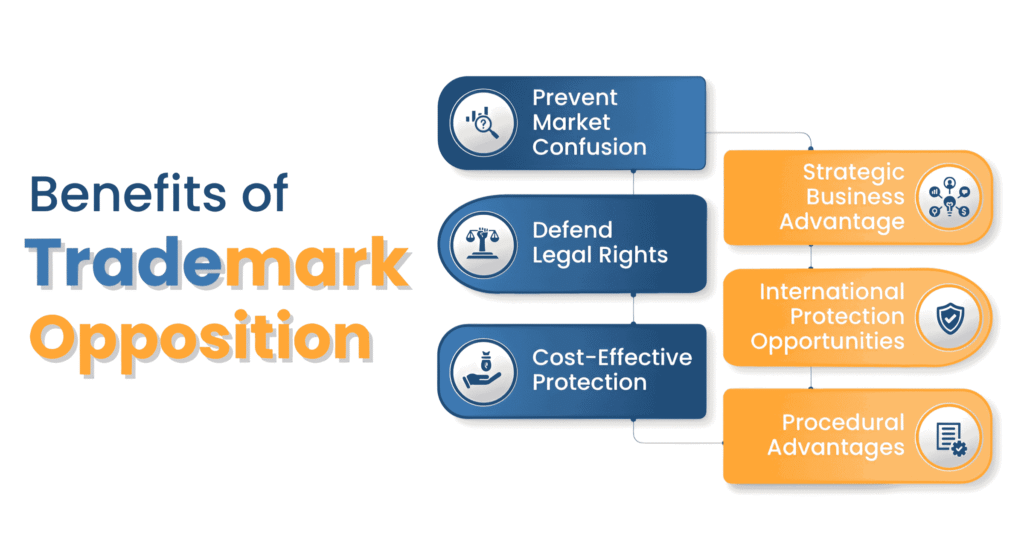
Why is Trademark Opposition Important?
Trademark opposition plays a key role in:
- Protecting existing trademark rights.
- Preventing consumer confusion in the market.
- Ensuring unique and valid trademarks are registered.
- Maintaining fair competition by blocking misleading or infringing marks.
Who Can File a Trademark Opposition and When?
This broad scope includes competitors, prior users, and even the general public if they believe the trademark registration is detrimental to their interests or violates legal/regulatory standards.
- Any person: This is a broad definition, encompassing individuals, companies, trusts, partnerships, and any legal entity.
- Prior users: If someone has been using a similar mark before the applicant, they can oppose the registration.
- Registered trademark owners: If the mark is similar to a registered trademark, the owner can oppose.
- Competitors: Businesses operating in the same or related fields can oppose if they believe the new mark is likely to confuse.
- General public: Even the public can oppose if they believe the mark is deceptive or harmful, although this is less common.
- Industry watchdogs: Organizations concerned with trademark protection may also oppose.
When to File a Trademark Opposition
- Within Four Months: The notice of opposition must be filed within four months from the date of publication of the trademark application in the Trademarks Journal.
- After Publication: Opposition can only be filed after the trademark application has been published in the journal.
- Once Published: It is crucial to monitor the Trademarks Journal for publications and act promptly if an opposition is warranted.
Grounds for Trademark Opposition
Here are some absolute and relative grounds for trademark opposition:
Absolute Grounds for Refusal under Section 9 of the Act
Section 9 of the Trade Marks Act, 1999 lists reasons to reject a trademark based on its nature. A trademark can be refused if it is not unique, is too descriptive, or goes against public policy or morals.
1. Lack of Distinctiveness
A trademark must be distinctive enough to differentiate the goods or services of one business from another.
Trademarks that are merely descriptive or generic are generally not registrable.
2. Descriptive Nature
Trademarks that simply describe the goods or services they represent (without any unique element) can be opposed.
For example, a trademark like “Chocolate Biscuits” for chocolate biscuits would likely be considered descriptive.
3. Bad Faith Applications
If a trademark application is filed to harm a competitor, usurp a well-known brand, or exploit another’s goodwill, it can be opposed.
4. Legal Prohibitions
Trademarks that are prohibited by law, such as those that are offensive, scandalous, immoral, or contrary to public policy, can be opposed.
5. Likelihood of Confusion or Deception
If a trademark is likely to mislead consumers about the origin, nature, or quality of the goods or services, it can be opposed.
For example, a trademark that implies a geographical origin that the goods do not possess.
Relative Grounds for Refusal under Section 11 of the Act
Section 11 of the Trade Marks Act, 1999 deals with refusal based on existing trademarks. A trademark can be rejected if it’s similar to an earlier mark and may confuse the public or harm someone else’s rights.
1. Similarity to Existing Trademarks
A trademark may be refused if it is:
- Identical or confusingly similar to an already registered trademark.
- Used for similar goods or services.
- Likely to cause confusion among the public or create a false connection between the two marks.
This ensures that customers are not misled and protects the legal rights of the original trademark owner.
Example: If a company tries to register “Apple” for electronic products, it could be opposed under Section 11 due to its similarity with the well-known brand “Apple.”
2. Likelihood of Confusion with Earlier Trademarks (Section 11(1))
This is the most common relative ground for refusal. A trademark will not be registered if:
- It is identical to an earlier trademark, and the goods or services covered by the new trademark are similar.
- It is similar to an earlier trademark, and the goods or services covered by the new trademark are identical or similar.
The crucial element here is the likelihood of confusion on the part of the public, which includes the likelihood of association with the earlier trademark. The Registrar assesses factors like:
- The similarity between the marks (visual, phonetic, conceptual).
- The similarity of the goods or services.
- The nature of the goods/services and the class of consumers.
3. Protection of Well-Known Trademarks (Section 11(2))
This subsection provides enhanced protection for well-known trademarks. A trademark will be refused registration if:
- It is identical to or similar to an earlier well-known trademark in India.
- It is to be registered for goods or services which are NOT similar to those for which the earlier well-known trademark is registered.
The refusal occurs if the use of the latter mark, without due cause, would:
- Take unfair advantage of the distinctive character or repute of the well-known trademark.
- Be detrimental to the distinctive character or repute of the well-known trademark.
This clause aims to prevent dilution and tarnishment of famous brands, even if the new mark is for different goods or services.
4. Prevention by Other Laws (Section 11(3))
A trademark will not be registered if its use in India is liable to be prevented by:
- The law of passing off: This protects unregistered trademarks used in the course of trade, preventing others from misrepresenting their goods or services as those of another.
- The law of copyright: If the trademark infringes on an existing copyright (e.g., a logo that is a copyrighted artistic work), its registration can be refused.
5. Consent of Earlier Trademark Proprietor (Section 11(4))
Notwithstanding the above, registration may be permitted if the proprietor of the earlier trademark or other earlier right consents to the registration. In such cases, the Registrar may register the mark under special circumstances.
Documents Required for Trademark Oppositions
To oppose a trademark, you’ll need to file a Notice of Opposition (Form TM-O) with the Registrar of Trademarks, along with supporting documents and the required fee.
This notice should clearly state the grounds for opposition, details of the trademark application, and information about both the applicant and the opponent.
- Notice of Opposition (Form TM-O): This is the primary document for initiating the opposition process.
- Application Details: The notice must include the application number of the trademark being opposed.
- Grounds for Opposition: Clearly state the reasons for opposing the trademark registration, such as similarity to an existing mark or lack of distinctiveness.
- Applicant and Opponent Information: Provide details about both the applicant (the one seeking registration) and the opponent (the one opposing the application).
- Evidence: Supporting documents to substantiate the grounds for opposition. This may include:
- Affidavits: Statements made under oath to support the opposition.
- Prior Use Evidence: Proof of prior use of a similar mark, such as sales invoices, product images, and advertising materials.
- Government Registrations: If the opposition is based on a prior registration, provide a copy of the registration certificate.
- Power of Attorney: If an attorney is representing the opponent, a Power of Attorney authorizes them to act on the opponent’s behalf.
- Fees: Pay the prescribed fee for filing the Notice of Opposition.
- Counter Statement: The applicant will have an opportunity to file a counter-statement to the opposition.
- Hearing Statements: If the opposition is contested, both parties may be required to submit hearing statements.
- Adjournment Requests: If needed, parties can request adjournments of the hearing.
Mode of Filing a Trademark Opposition Application
A Trademark Opposition (Form TM-O) must be filed within four months of the trademark’s publication in the Trademarks Journal.
Filing can be done either online (e-filing) or offline, with online being preferred for convenience and potential cost savings.
1. E-filing (Online Filing):
- E-filing involves submitting the Notice of Opposition and required documents through the Indian Trademark Registry’s online portal.
- This method often includes a fee discount compared to physical filing.
- E-filing is considered faster and more efficient.
- To e-file, one needs to register on the IP India portal and use a Class 3 Digital Signature Certificate (DSC).
2. Offline Filing (Physical Filing):
- Physical filing involves submitting the TM-O form and documents in person at the Trademarks Registry Office.
- The fee for offline filing is generally higher than for online filing.
- After manual filing, it may take some time to receive an acknowledgment receipt.
- Offline filing can be useful if online access or technical issues arise.
Trademark Opposition Procedure in India
The process of trademark opposition is as follows:
1. Notice of Trademark Opposition
Any person can file for trademark opposition with the Registrar within 4 months from the date of advertisement of the registration application in the trademark journal by submitting a notice in Form TM-O and paying the prescribed fees.
The notice should contain the application (trademark registration application) details, the opposing party details, and the grounds of opposition. The Registrar should serve a copy of the notice of opposition to the applicant (the person who filed the trademark registration application).
2. Counterstatement for Notice of Trademark Opposition
The applicant must file their counterstatement to the notice of opposition with the Registrar in Form TM-O within 2 months of receiving a copy of the notice of opposition, stating their facts. The Registrar will serve a copy of the counterstatement to the opposing party.
If the applicant does not file the counter-statement within 2 months of receiving the notice of opposition, the Registrar will consider that the trademark registration application is abandoned and thus will not proceed to register the trademark.
3. Evidence For and Against Trademark Opposition
The opposing party shall provide evidence supporting their notice of opposition to the Registrar within 2 months of receiving a copy of the counterstatement filed by the applicant. The opposing party should also send all copies of the evidence to the applicant.
Upon receiving the evidence copy from the opposing party, the applicant should file their evidence in support of the trademark registration application within 2 months of receiving the opposing party’s evidence copy. The applicant must send their evidence to both the Registrar and the opposing party.
The opposing party can file further evidence within 1 month of receiving the copies of the application. The opposing party must submit further evidence to both the Registrar and the applicant.
4. Hearing and Decision Concerning Trademark Opposition
The Registrar, after the receipt of evidence from both parties and further evidence from the opposing party, will give notice to both parties of the first date of hearing. If the opposing party is not present on the hearing date, the opposition will be dismissed, and the Registrar will register the trademark.
If the applicant is not present on the hearing date, the registration application will be treated as abandoned and dismissed. The Registrar will consider the written arguments submitted by both parties to the proceeding.
After hearing both parties and considering the evidence submitted by them, the Registrar will decide whether to proceed with the trademark registration or reject the trademark registration application. The decision of the Registrar will be communicated to both parties in writing at the address provided by them.
Forms for Trademark Oppositions
In trademark opposition proceedings in India, specific forms are prescribed for various actions.
The primary form for initiating an opposition is Form TM-O, while Form TM-M is utilized for various ancillary requests that may arise during the opposition process.
Form TM-O
- Purpose: Used to formally oppose a trademark application published in the Trade Marks Journal.
- Filing: Must be filed within four months of the trademark’s advertisement in the Journal.
- Contents: Includes the trademark application details, the opponent’s details, and the grounds for opposition.
- Fee: Requires payment of a prescribed fee, which may vary based on the number of grounds cited.
- Key Sections: Used for opposition under Section 21(1), and can also be used for other rectification actions.
Form TM-M
- Purpose: Used for various post-registration or pre-registration requests related to trademarks, including some used in opposition proceedings.
- Filing: Can be used for different types of requests, such as applying for expedited processing, requesting extensions of time, or making other amendments to trademark applications or registrations.
- Contents: The form is divided into sections, with Part A for applicant and agent details and Part B for selecting the specific request and providing relevant details.
- Key Sections: Can be used for requesting rectification of the register.
- Multiple Requests: Only one request can be made per Form TM-M.
Costs Involved in a Trademark Opposition Proceeding
A trademark opposition proceeding involves official government fees, professional fees for an attorney, and other potential costs.
1. Official Government Fees
- Filing Notice of Opposition: ₹2,700 for one class of goods or services.
- Filing Counter Statement: ₹2,700 for one class of goods or services.
- Evidence (Affidavit): No official fee for filing evidence by way of affidavit.
2. Professional Fees for a Trademark Opposition Attorney
- Varying Costs: Attorneys’ fees can range from ₹5,000 to ₹50,000 or more.
- Factors Affecting Cost: Complexity of the case, duration of the opposition, and the attorney’s experience level.
- Example: One source suggests fees ranging from ₹5,000 to ₹15,000.
3. Other Costs to Be Aware Of
- Evidence Gathering: Expenses related to gathering evidence to support the opposition or defense.
- Expert Witnesses: Costs associated with hiring expert witnesses, if needed.
- Litigation: If the opposition proceeds to litigation, additional court fees and legal costs will be incurred.
- Opponent’s Fees: If the opposition is successful, the applicant may be required to reimburse the opponent’s costs.