What is the Winding Up of a Company?
Winding up represents the formal process of bringing a company’s business operations to a close. It signifies the lawful end of a corporate entity’s life. The process involves several key actions:
- Stopping all business activities
- Selling the company’s assets
- Settling debts with creditors
- Distributing any remaining assets among shareholders.
In India, the Companies Act, 2013, and the Insolvency and Bankruptcy Code (IBC), 2016, primarily govern this entire procedure. A professional, referred to as a liquidator, is appointed to oversee and manage this complex process.
Throughout the winding-up process, the company retains its legal identity and can continue to participate in legal proceedings.
Modes of Winding Up of a Company
Indian law offers different ways to close a company, depending on its situation and financial condition:
Compulsory Winding Up (By the Tribunal)
This occurs when a court or tribunal mandates the company’s closure. In India, the power to wind up a company lies with the National Company Law Tribunal (NCLT), as explained in Section 271 of the Companies Act, 2013. The process typically begins with a formal petition filed before the NCLT.
Here’s who can file such a petition:
- Company
- Its creditors or shareholders (known as contributories)
- Registrar of Companies (ROC)
- The Central or State Government (in case of public interest)
The grounds include the company’s inability to pay its debts. This is presumed if a creditor’s demand for payment (exceeding ₹1 lakh) remains unsettled for 21 days. Other grounds include:
- Fraudulent conduct of affairs
- Acting against India’s sovereignty or integrity
- Failing to file financial statements or annual returns for five consecutive years
- Just and equitable reasons as determined by the Tribunal.
If the NCLT finds a valid case, it admits the petition and appoints an official liquidator.
Voluntary winding up is initiated by the company’s members (shareholders) or creditors, without direct court intervention. This self-initiated procedure typically begins with the company passing a special resolution in a general meeting.
There are two distinct forms of voluntary winding up:
- Members’ Voluntary Winding Up: This method is chosen when the company is solvent and fully capable of paying all its debts.
- Creditors’ Voluntary Winding Up: This happens when a company cannot pay all its debts and is declared insolvent.
A solvent company capable of paying its debts can use the voluntary winding-up process with minimal court involvement. However, if a company is insolvent and cannot pay its debts, the process requires stronger creditor protections, leading to a compulsory winding up or a creditors’ voluntary winding up.
Key Aspects of Winding Up of a Company
The winding-up process includes several important elements to ensure it’s done legally and in an organized way.
- A liquidator plays a key role in the process. Their job is to manage the entire closure. This includes converting assets into cash, paying off debts, and distributing leftover funds to shareholders.
- The liquidator’s appointment depends on the type of winding up: in voluntary cases, members or creditors appoint one; in compulsory cases, the court does.
- A strict order of payment is followed when settling liabilities. This prioritizes secured creditors (like banks), then employees (for unpaid salaries and benefits), followed by government dues (like taxes).
- Only after these obligations are fulfilled, any leftover money is distributed to shareholders. This hierarchy helps protect the rights of those most at risk during closure.
Difference Between Winding Up, Dissolution & Liquidation of a Company
These terms are often used interchangeably, but they represent distinct stages in the process of closing a company.
Governing Laws For Winding Up a Company
The winding up of companies in India is primarily governed by two key legislative frameworks:
This Act provides a comprehensive structure for winding up procedures, particularly under Chapter XX (Sections 270 to 365). It outlines provisions for both compulsory winding up by the Tribunal and, historically, voluntary winding up.
However, after the enforcement of the Insolvency and Bankruptcy Code (IBC), 2016, most provisions related to voluntary winding up under the Companies Act have been omitted or made inapplicable. As of now, only winding up by the Tribunal continues to be governed under the Companies Act, 2013 (specifically under Section 271 and onwards).
The Insolvency and Bankruptcy Code (IBC), 2016
With its enactment, the IBC, particularly Section 59, now largely governs voluntary liquidation for corporate persons. The IBC focuses on making the resolution process faster and more efficient. It also covers compulsory liquidation procedures, especially when a company is unable to pay its debts.
Advantages of Winding Up a Company in India
Winding up a company, while signifying an end, offers several advantages, particularly when a business is no longer viable or has served its purpose.
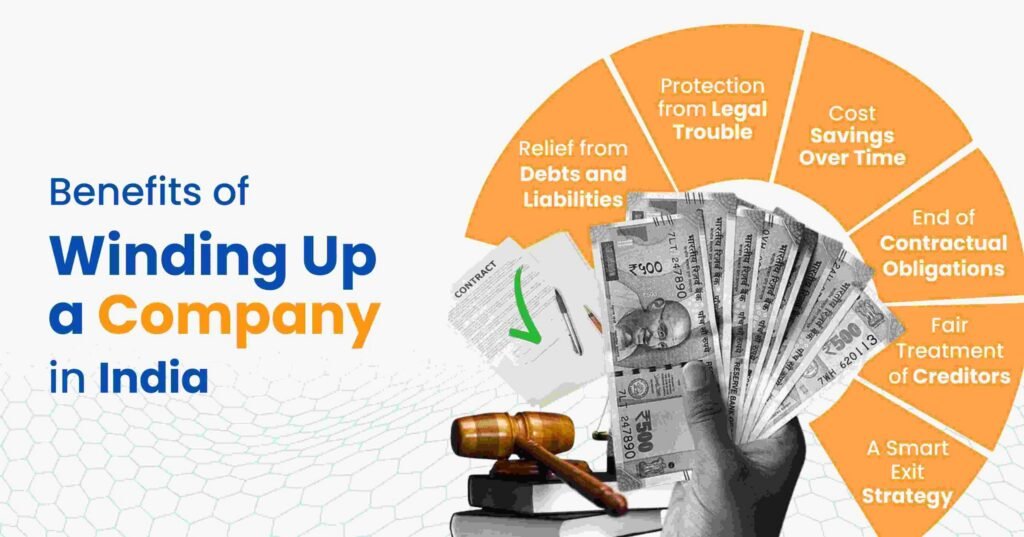
benefits of winding up a company in india[/caption]
Relief from Debts and Liabilities
Once the liquidation process is completed, the company’s directors and administrators are no longer responsible for settling debts or dealing with creditors.
This allows them to move forward with a fresh start, free from previous financial stress.
Protection from Legal Trouble
Choosing voluntary winding up can help a company avoid possible legal action from courts or regulatory bodies due to ongoing non-compliance or financial issues.
This proactive decision lets directors shift focus to new business ideas without worrying about old legal problems.
Cost Savings Over Time
Keeping an inactive or non-operational company still comes with regular costs, such as filing fees and audit expenses.
Liquidation puts an end to these yearly costs, helping save money in the long run.
Often, the expenses involved in winding up are covered by selling off company assets, making it more affordable than continuous compliance.
End of Contractual Obligations
During the winding-up process, certain long-term agreements—like leases—can be canceled.
This helps the company stop paying for contracts it no longer needs.
Fair Treatment of Creditors
Liquidation follows a set process that ensures creditors are notified and their claims are handled in a fair and transparent manner.
Creditors can assess the situation based on official credit statements and prepare for any shortfalls.
Provides a Strategic Business Exit
Winding up a company that is inactive or not profitable can be a strategic move.
It reduces legal and financial pressure, giving directors and shareholders a chance to explore fresh opportunities without being tied to past obligations.
Consequences of Winding Up a Company in India
While winding up offers benefits, it also carries significant disadvantages for the company and its stakeholders.
Once a company is dissolved, it loses its legal status and is no longer recognized as a separate legal entity.
It cannot sign contracts, enter into civil transactions, or take part in legal proceedings.
Asset Liquidation and Debt Settlement
The main goal of liquidation is to sell the company’s assets and use the proceeds to pay off debts. Creditors are paid first, including employees and government dues.
Shareholders receive money only if there’s anything left after all debts are cleared. If the company’s assets are not enough, creditors may get only a part of what they are owed.
If the company is wound up due to a creditor’s petition, it can signal financial distress or insolvency. This may harm the company’s creditworthiness and public reputation.
It could also lead to loss of customers and defaulting on other obligations, worsening the financial situation.
Legal Restrictions and Consequences
Once a winding-up petition is filed, the company cannot sell or transfer assets without court approval.
Directors may face legal action if they commit fraud or attempt to hide assets during the process.
All pending tax dues, such as income tax and GST, must be cleared during the winding-up process.
The liquidator may need a tax clearance certificate before the company can be officially closed.
Directors’ Personal Liability
In most cases, directors are not personally responsible for the company’s debts unless they:
- Engaged in fraud,
- Breached their legal duties, or
- Violated specific statutory rules.
The Supreme Court has clarified that directors’ liability usually begins after a winding-up order is issued. If fraud is found, directors can be held personally responsible for the company’s losses.